TLDR
Choose coffee labels by starting with the actual package—not a blank artwork file. Identify the surface, environment, application method, quantity, and information the label must carry. Measure only the flat, stable panel that remains after accounting for pouch gussets, zippers, tear notches, heat seals, degassing valves, bottle curves, and seams. Use sheets for flexible short runs and rolls for repeatable hand or machine application. Test the complete label construction on filled, package-representative samples before scaling, particularly for cold brew, oily handling, or flexible bags.
Coffee labels have two jobs: present the brand clearly and remain usable on the real package. A beautiful label can wrinkle across a pouch fold, lift from a textured bag, obscure a valve, or become difficult to scan when wrapped too far around a bottle. The early answer is simple: define the usable label panel and operating conditions before choosing a material, finish, size, or format.
Start with the coffee package, not the artwork
Begin with five questions: What surface must the label stick to? What environment will it experience? How will it be applied? How many labels are needed? What must the design communicate and survive? These questions expose the tradeoff among appearance, durability, application speed, production format, and cost.
A kraft-look pouch, smooth laminated bag, glass jar, painted tin, metal can, and plastic cold-brew bottle are different labeling surfaces. Even packages that look similar may have different coatings, textures, surface energy, flexibility, or contamination from dust and oils. The responsible approach is to identify the exact package specification and test an actual sample rather than assume that one adhesive works across every coffee container.
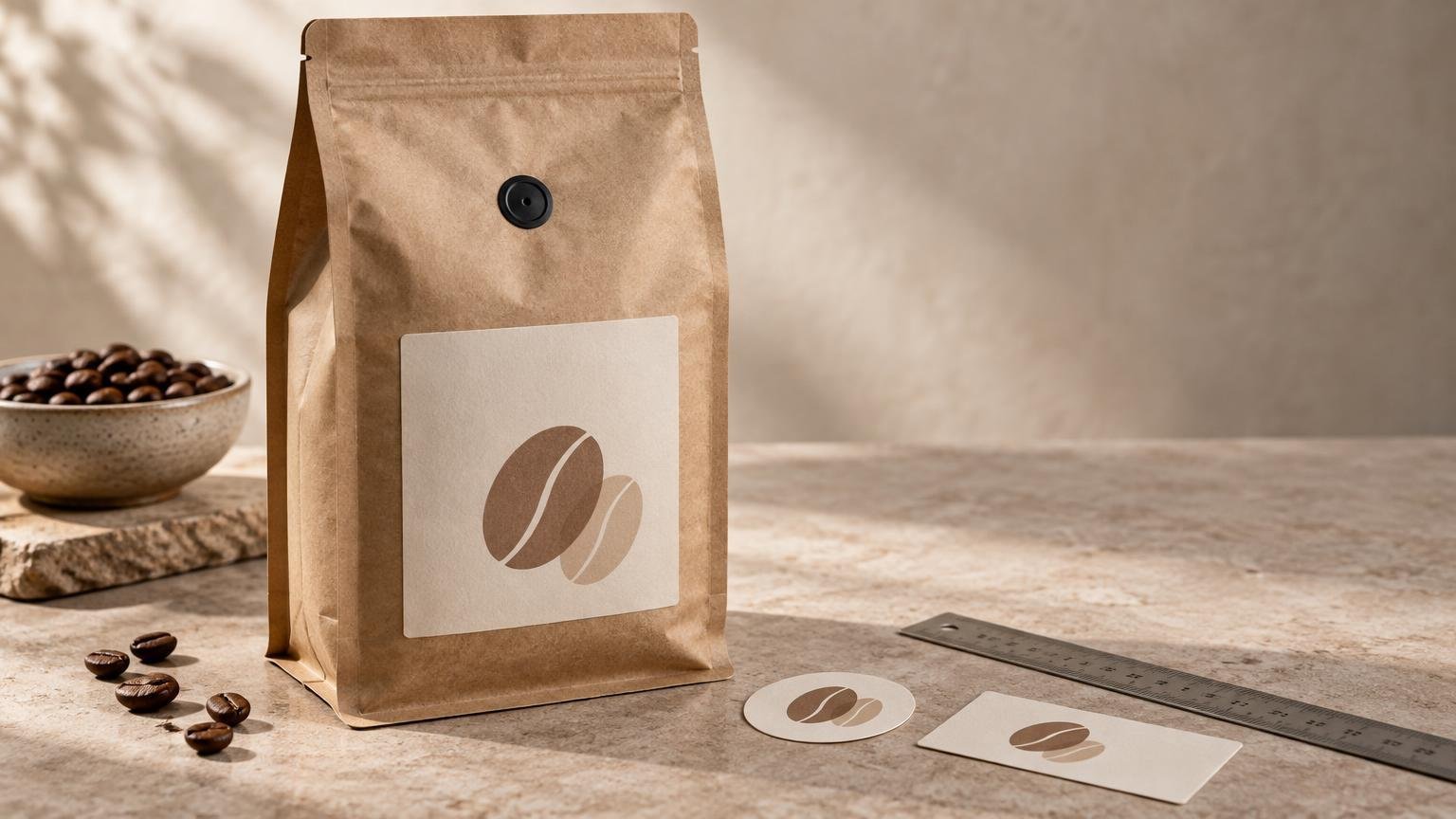
For a stand-up pouch, fill it with the intended product or a representative substitute before measuring. Let the bottom gusset open naturally. Mark the flat front and back panels, then exclude the zipper, tear notch, top and bottom seals, side folds, and any area that changes shape when the bag is handled. A label that fits an empty pouch may buckle after the pouch expands.
On bottles and jars, measure the straight-sided label panel instead of the full container height. Curved shoulders and bases increase the risk of wrinkling or edge lift. Use a paper strip to simulate a wrap, mark where its ends meet, and decide whether the final design needs a gap or controlled overlap. The detailed bottle-label measuring process can help with cylindrical cold-brew bottles and coffee jars.
Treat the degassing valve as a no-label zone
A degassing valve is a functional package feature, not unused design space. Do not place a label over it or position an edge so close that normal application tolerances could partly cover it. Leave enough open space for the valve to remain unobstructed and easy to inspect. If the valve sits near the center of the front panel, consider a shorter label, an offset design, separate front and back labels, or packaging with a valve position better suited to the intended branding.
Create a simple package dieline that marks the valve, seals, folds, zipper, notch, gusset, and safe label panel. Photographing a ruler beside a filled pouch is also useful when the designer and production buyer are not working in the same location.
Choose a label format for the application workflow
CustomLabels lists sheet labels, roll labels, food and beverage labels, variable-data labels, and several finish categories among its current options. The best format depends less on the coffee itself than on how frequently labels change and how they reach the package.
| Format | Usually practical for | Main production consideration |
|---|---|---|
| Sheet labels | Short launches, several SKUs, and manual application | Easy to distribute in small batches, but repetitive peeling and alignment can slow larger runs. |
| Roll labels | Repeated hand application, dispensers, or compatible applicators | Confirm roll width, core, winding direction, gap, and leading edge with the application workflow. |
| Separate front and back labels | Pouches or containers with interrupted panels | Keeps branding and required copy away from valves, seams, and curves. |
| Small variable labels | Roast date, lot code, origin, or rotating SKU details | Plan how variable information will be printed, written, or applied without obscuring fixed copy. |
| Wrap labels | Straight-sided jars, cans, or bottles | Check circumference, overlap or gap, seam position, and barcode placement. |
Roll labels can support hand or machine application, and current CustomLabels product information describes multiple shapes, materials, finishes, and adhesive choices. Machine use still requires equipment-specific information; there is no universal unwind direction. Ask the applicator or co-packer for roll orientation, maximum roll diameter, core size, web width, label gap, and which label edge must dispense first. The broader roll-label versus sheet-label comparison explains how format affects production.
Keep identification labels distinct from secondary promotional pieces. Coffee labels should carry stable product and regulatory information, while removable event messaging or box inserts may use separate custom stickers when that is operationally simpler.
Match the construction to real conditions
A label construction combines the printable face material, adhesive, protective finish when used, and release liner. Choosing only by whether the surface looks glossy or matte overlooks the parts that determine application and survival.
A dry, shelf-stable bag stored indoors presents a different challenge from a refrigerated cold-brew bottle that develops condensation. Flexible pouches repeatedly bend and squeeze; jars may encounter abrasion during packing; oily coffee residue can contaminate a surface before application. CustomLabels’ packaging guidance recommends considering surface texture, refrigeration or condensation, oil exposure, application method, and real-world testing before scaling.
Paper can create a familiar craft appearance for a dry retail bag, but appearance alone does not establish compatibility with a coated or textured pouch. Clear labels can make glass, metal, or the package color part of the design. The current clear-roll-label page describes glossy transparent and matte or frosted options for certain metal, plastic, and glass applications, while characterizing that product as water-resistant and intended for indoor use. That is not a universal promise for coffee bags, refrigeration, ice buckets, or prolonged condensation.
Before a larger order, apply samples to clean packages under normal production conditions. Fill and seal the packages, then expose them to the actual storage, shipping, refrigeration, handling, and abrasion cycle. Inspect corners, edges, folds, print surfaces, and scanning performance over time. A small-batch packaging test is more informative than testing a label on an unrelated household container.
Plan coffee-label artwork around the usable panel
Design at final size. Keep essential text, logos, barcodes, and QR codes inside a safe area away from the cut edge. Extend background colors or images through the printer’s required bleed area so minor cutting variation does not leave an unintended unprinted border. Use the current template or production specification rather than assuming a generic bleed value.
Build a clear information hierarchy. The front can prioritize the brand, coffee identity, roast descriptor, origin, and net quantity where required. The back or side can carry brewing guidance, flavor notes, process information, business details, ingredients when applicable, and other product-specific copy. Roast date, lot code, and rotating origin data may be easier to manage as variable information than as part of the fixed design.
Keep barcodes on a smooth, stable area that will not cross a pouch fold, wrap seam, strong curve, transparent visual clutter, or metallic glare. Print and scan the code at final size on the real package. QR codes deserve the same test: verify contrast, quiet space, destination, and scanning under normal retail lighting.
Clear facestock requires an extra artwork decision because unprinted areas reveal the package. Dark coffee, brown glass, kraft graphics, or shiny metal can reduce contrast. White ink may be used in some clear-label workflows to make selected areas opaque, but availability and setup should be confirmed for the exact product configuration before artwork is finalized.
Separate merchandising copy from required food-label information
Origin, farm or cooperative, variety, elevation, processing method, roast level, flavor notes, brew recipe, roast date, and lot number can help buyers understand the coffee and help the business manage inventory. Whether these items are appropriate depends on the product and the accuracy of the claims. They do not replace legally required information.
For packaged foods sold in the United States, the FDA’s Food Labeling Guide outlines common elements such as the statement of identity, net quantity declaration, and name and place of business. Foods made with two or more ingredients generally require an ingredient list, and major allergens must be declared when present. Placement, wording, type size, exemptions, and jurisdictional details require review for the actual product.
FDA guidance identifies whole or ground coffee beans and plain, unsweetened instant coffee among foods that may qualify for a Nutrition Facts exemption because they contain insignificant amounts of relevant nutrients or components. This is a narrow point, not a blanket coffee-label exemption. It does not remove other applicable labeling duties, and it should not be assumed to cover flavored coffee, sweetened coffee, ready-to-drink beverages, creamers, multi-ingredient blends, or products making nutrient claims.
A print provider produces the physical label; it does not determine whether the final copy complies with every applicable federal, state, local, marketplace, or export requirement. Final legal copy should be reviewed for the specific formulation, claims, package, jurisdiction, and sales channel before printing.
Review organic and other claims separately
USDA limits use of organic terminology to agricultural products produced and handled under applicable organic rules or an equivalent program. Its guidance distinguishes categories such as “Organic” and “Made with organic …” and applies separate conditions to use of the USDA Organic seal. Confirm the coffee’s certification status, percentage category, certifier details, ingredient composition, and proposed wording before placing an organic claim or seal on the label.
Apply the same discipline to claims about geography, sustainability, decaffeination, health, environmental impact, or third-party certification. Keep documentation for the exact claim and reproduce certification marks according to the issuing organization’s rules.
Coffee label order checklist
- Obtain the exact production pouch, jar, tin, can, or bottle—not only a supplier drawing.
- Identify the substrate, coating, texture, curves, flexibility, and potential surface contamination.
- Fill the package and mark the stable label panel, excluding valves, folds, seams, zippers, notches, gussets, and curved shoulders.
- Document storage and use conditions, including refrigeration, condensation, oils, abrasion, heat, and shipping.
- Choose sheet or roll format according to quantity, SKU variation, hand application, dispenser use, or applicator requirements.
- For machine application, confirm core, roll diameter, web width, gap, winding direction, and leading edge with the equipment owner.
- Design at final size using the current printer template, bleed, safe-area, and file requirements.
- Test small text, contrast, barcodes, QR codes, clear areas, and any white-ink layers on the actual package.
- Separate fixed branding from changing roast dates, lot codes, origins, or other variable data.
- Complete a product-specific regulatory review before approving food-label copy.
- Apply samples under normal production conditions and run package-representative storage and handling tests.
- Approve the larger order only after fit, adhesion, appearance, legibility, and application speed are acceptable.
Make the package sample the final decision-maker
The right coffee label begins with the physical container and its workflow. Protect the degassing valve, stay clear of folds and seals, choose a format that operators can apply consistently, and test the complete construction under real conditions. Once the production specification works, finalize the artwork and complete a separate compliance review. That sequence prevents an attractive design from becoming an expensive packaging problem.
References
- Shop Labels – CustomLabels
- Roll Labels Archives – CustomLabels
- How to Measure a Bottle for a Label Without Guessing – CustomLabels
- Custom Labels For Small Batch Products: How To Test Packaging Before You Scale – CustomLabels
- Clear Roll Labels – CustomLabels
- Guidance for Industry: Food Labeling Guide | FDA
- Food Labeling Guide
- Labeling Requirements for the U.S. Organic Market | Agricultural Marketing Service