A pressure-sensitive label can be rated to survive a freezer and still fail when applied to a cold bottle. That is not necessarily a contradiction. Application temperature describes the conditions during installation; service temperature describes what the bonded label can tolerate afterward. Confusing the two is a common cause of lifting edges, sliding labels, wrinkles, and labels that detach during refrigerated distribution.
TLDR
The minimum application temperature is the lowest temperature at which a particular label construction should be applied to a prepared surface. The service-temperature range describes the temperatures that construction may tolerate after it has been applied correctly and developed an adequate bond. Always verify both specifications, along with the container material, surface condition, moisture exposure, application pressure, dwell time, and print method. A freezer-capable label is not automatically a label that can be applied successfully inside a freezer.
The two temperature specifications answer different questions
| Specification | Question it answers | When it matters |
|---|---|---|
| Application temperature | How warm or cold may the label and package be when the label is installed? | During hand or machine application and initial bonding |
| Service temperature | What temperatures may the bonded construction experience afterward? | During storage, shipping, display, use, and temperature cycling |
Pressure-sensitive adhesive must flow into the microscopic irregularities of a surface. At an unsuitable application temperature, the adhesive may be too firm to establish enough contact, even if it can withstand much colder conditions after bonding. Firm, even pressure and suitable dwell time help the adhesive wet out the surface and build adhesion.
This distinction appears clearly in supplier data. The Avery Dennison adhesive technical guide gives many ambient-use adhesives a minimum application temperature of 5°C or 41°F and a typical service range of –20°C to 80°C, or –4°F to 176°F. Those figures are a supplier-specific general guide, not a universal rating for every label.
A more specialized example makes the gap even clearer. The 3M technical data for 7818 polyester label material lists a minimum application temperature of 50°F or 10°C but a service range of –40°F to 300°F, or –40°C to 149°C. In other words, the construction may tolerate substantial cold after bonding even though 3M does not specify it for initial application at those low temperatures.
Start with five questions before choosing a label
- What surface must the label stick to: glass, PET, HDPE, polypropylene, metal, paperboard, or flexible packaging?
- What environment will it experience during application, storage, distribution, display, and use?
- Will labels be applied by hand or by machine, and what pressure and speed will the process provide?
- How many labels are needed, and can the process be tested before the full production run?
- What must the complete label communicate and survive, including moisture, abrasion, heat, cold, flexing, and print-image durability?
Temperature is only one variable in that decision. The usable range belongs to the complete construction: facestock, adhesive, liner, ink or toner, protective laminate or varnish, package surface, label geometry, and application process. Avery Dennison consequently advises testing the complete construction in the actual application rather than treating an adhesive data point as a blanket promise.
Why the package surface changes the result
A specification that works on glass cannot be assumed to work identically on every plastic. Glass and PET are relatively favorable, higher-surface-energy substrates, while HDPE is a more difficult low-surface-energy plastic. Dust, oils, mold-release residue, and moisture can make bonding harder still.
The 3M 7818 data illustrates the difference. Under its stated test conditions, 180-degree peel adhesion after ten minutes at room temperature was reported as 52 ounces per inch on glass, 43 on stainless steel, 18 on polypropylene, and 20 on LDPE. These are product- and test-specific results, not general rankings for every adhesive, but they show why “works on plastic” is not a useful purchasing specification.
Container shape matters too. A label wrapped around a small-diameter tube or compound curve is constantly trying to straighten itself. That creates edge-lifting stress. Squeezable packaging adds flexing, while a paperboard carton may absorb moisture or present a textured surface. The adhesive must suit both the material and the mechanical demands of the package.
Cold and wet application is a process problem
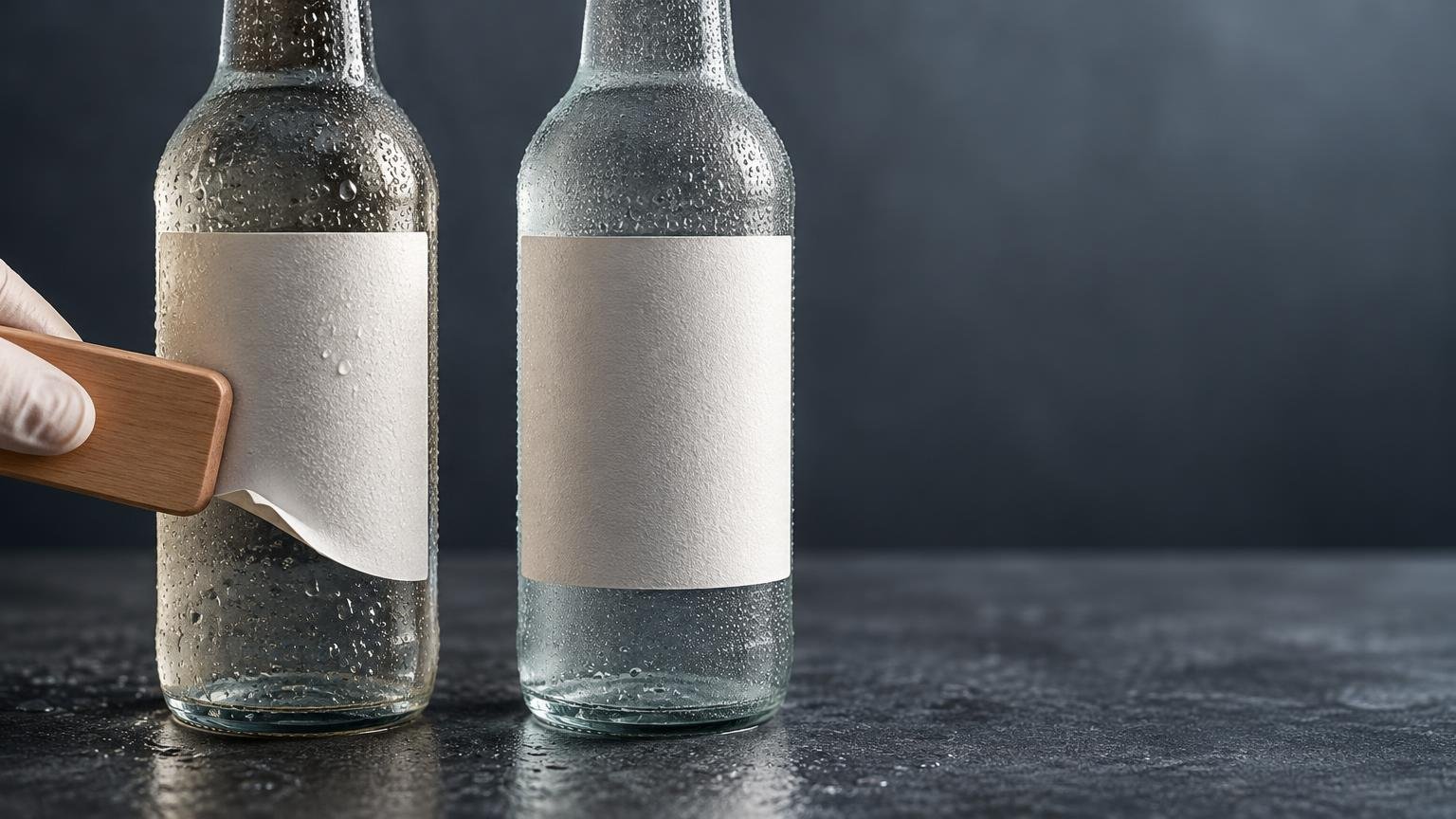
A beverage bottle emerging from a chiller may be both cold and covered in condensation. Those are separate obstacles: low temperature can make an adhesive less willing to flow, while water can prevent direct adhesive-to-container contact.
Avery Dennison’s cold and wet bottle guidance says excessive water can allow the label to slide and fail to bond. Drying close to the labeling point and controlling wipe-down pressure are therefore relevant process variables. Too little pressure can leave edges unsecured; excessive or uneven pressure can shift the label before it grips.
For a small hand-labeling operation, the practical fix may be to let containers warm and dry before application, clean them with a method compatible with the packaging, apply labels with consistent pressure, and allow an appropriate dwell period before refrigeration. A production line may instead require controlled drying, a purpose-selected cold/wet adhesive, calibrated wipe-down equipment, and verified line speed.
Do not solve the problem by selecting the lowest advertised temperature alone. Avery Dennison lists its specialized S2196 cold-chain adhesive as applicable at –50°C or –58°F and serviceable down to –196°C or –321°F. Those figures describe a specialized construction, not ordinary product-label stock.
Bond strength can develop after application
A newly applied label may not have reached its eventual adhesion. The 3M 7818 data reports peel results after both ten minutes and 72 hours of room-temperature dwell, demonstrating that bond performance can develop over time.
That makes process timing important. Applying a label in a warm room and immediately moving the package into a freezer may produce a different result from allowing the bond to develop first. Ask the material supplier what dwell conditions apply to the exact construction; do not invent a universal waiting period.
Temperature can also change adhesive behavior rather than merely weakening it. Avery Dennison notes that an adhesive designed to be removable at room temperature may act more like a permanent adhesive at lower temperatures. That matters for reusable containers, promotional labels, temporary logistics identification, and any application where clean removal is part of the requirement.
The adhesive may not be the first component to fail
Service temperature is not solely an adhesive question. Facestock can shrink, stiffen, soften, or distort. A laminate can change appearance. Ink may fade or abrade, and a direct-thermal image can darken under heat even while the adhesive remains attached.
For example, Avery states that one direct-thermal label range has an adhesive operating range of approximately –65°F to 200°F, while the thermal image may discolor above 150°F. The lower practical upper limit is therefore imposed by image performance, not adhesive retention.
The same complete-system reasoning applies when coordinating labels with cartons, inserts, or other custom printing and print-production work. Color, finish, handling, and environmental exposure should be evaluated across the package rather than specified as unrelated pieces.
How to specify the right temperature range
Do not ask only for a “freezer label” or a “heat-resistant label.” Give the converter or supplier a description of the actual workflow. If you are still comparing available formats and finishes, the label categories and styles overview is a useful starting point, but construction-specific temperature ratings should be confirmed for the exact product being ordered.
- Record the label, package, and room temperatures at the point of application.
- Identify the package substrate precisely; “plastic bottle” is not enough.
- Describe condensation, washdown, oils, cleaners, abrasion, UV exposure, and temperature cycling.
- Provide the lowest and highest expected service temperatures, including shipping and storage excursions.
- State whether labels are applied by hand or machine, along with applicator type, line speed, core size, and required unwind direction where applicable.
- Confirm the facestock, adhesive, liner, print process, ink system, and protective laminate or varnish as one construction.
- Ask how much dwell time is required before cold, heat, moisture, or handling exposure.
- Test labels on filled production containers rather than only on clean, empty samples.
For demanding distribution environments, a test plan is more useful than a vague durability claim. ASTM D7932-17(2023) provides a specification and acceptance framework for printed pressure-sensitive labels exposed to extreme distribution conditions, including chemicals, weather, heat, and cold. It does not assign one universal temperature range to every label.
Run a small pilot across realistic variables: containers from normal production, the coldest expected application condition, wet and dry surfaces where relevant, normal operator or machine pressure, and the intended dwell period. Then inspect for edge lift, sliding, tunneling, wrinkles, print discoloration, abrasion, adhesive residue, and scan performance if the label carries a barcode or QR code. The small-batch packaging test process can help structure that trial before quantities increase.
Choose for the moment of application and the life afterward
The correct label must pass two different temperature tests. First, it must establish a reliable bond under the actual application conditions. Second, the complete bonded construction must survive the temperatures and other stresses it encounters during its service life.
Treat the minimum application temperature and service-temperature range as separate specifications. Then verify the surface, moisture, pressure, dwell time, geometry, print method, and full label construction. That approach prevents a technically freezer-tolerant label from becoming a practically unusable label on a cold, wet production line.