TL;DR
Short-run label printing is usually the better choice when demand is uncertain, artwork changes frequently, a product has several small SKUs, or the label construction still needs real-package testing. There is no universal quantity that makes an order a short run. Compare the total cost of a small batch with the cost and risk of storing, revising or discarding a larger one. Before ordering, define the surface, environment, application method, quantity and information the label must communicate and survive.
A small order does not excuse a vague specification. The label still needs the right facestock, adhesive, finish, format and artwork for its container. A carefully planned short run can reveal lifting edges, wrinkling, scuffing, condensation problems and barcode failures before those problems spread across thousands of packages.
What counts as a short label run?
“Short run” describes the production context rather than a fixed quantity. Ten thousand labels may be a major commitment for a new candle maker but a brief trial for an operation that normally consumes millions. UPM Adhesive Materials identifies digital printing as a good fit for short runs, variable data, quick production and frequent design changes. It also highlights uses such as small-SKU packaging, serialization, promotional versions and batch-specific changes. UPM’s digital label overview provides more detail on these applications.
Digital production commonly makes small batches practical because artwork can change without preparing a conventional printing plate for each version. That does not mean digital is automatically the cheapest choice at every quantity. The crossover depends on label size, material, number of versions, finishing, setup, waste and application requirements. Ask for comparable quotes rather than choosing by unit price alone.
When a small batch beats a long production run
| Situation | Why a short run helps | What to confirm |
|---|---|---|
| New product or uncertain demand | Limits obsolete packaging if sales or positioning changes | Enough labels for a meaningful launch and reorder lead time |
| Several flavors, scents or sizes | Lets each SKU use an appropriate quantity | Version control and clear file naming |
| Seasonal or promotional packaging | Matches inventory to a limited selling window | Campaign dates and leftover-label risk |
| Variable barcodes or serial numbers | Supports changing data within the production workflow | Data format, verification and duplicate prevention |
| Package or material trial | Exposes adhesion and durability problems before scale | Actual containers, filling process and service environment |
| Regulated copy under review | Reduces the amount exposed to a future text revision | Approval workflow and current governing requirements |
The strongest economic case often comes from avoided waste rather than the lowest per-label price. Suppose a large run cuts the unit price but leaves half the labels unusable after an ingredient, address, barcode or package size changes. The apparent saving disappears. A short run buys flexibility while the product and packaging system stabilize.
This approach is especially useful during a packaging test. The process in our guide to testing custom labels for small-batch products can help turn the initial order into a controlled trial rather than an expensive guess.
Specify the package before choosing the print run
Start with five questions: What surface must the label stick to? What environment will it experience? How will it be applied? How many labels are needed? What must the design communicate and survive? These questions determine whether a small batch will produce useful evidence for a later run.
Surface and container geometry
Glass, coated paperboard, metal and plastic can present different adhesion conditions. Surface energy, texture, contamination and container curvature all matter. Tight-radius bottles and tubes place continual stress on the label edges, a property sometimes described as mandrel hold. Avery Dennison also notes that adhesion builds over time and that the minimum temperature for applying a label differs from the temperature range it may tolerate after application. Avery Dennison’s adhesive glossary explains these terms.
Test labels on production containers, not merely on a similar jar found nearby. Clean and label them under realistic conditions, then allow the adhesive to build before judging the result. Include filled packages if filling changes the surface temperature, creates condensation or exposes the label to oil.
Environment and construction
A glossy or matte appearance does not by itself establish resistance to water, abrasion, heat, chemicals or ultraviolet exposure. Performance comes from the complete construction: facestock, adhesive, ink system and any laminate or varnish. A refrigerated drink may need to tolerate condensation, while a candle label may face oils, handling and warmth. Ask for the exact construction proposed for the job and test it against the expected exposure.
Application method and supply format
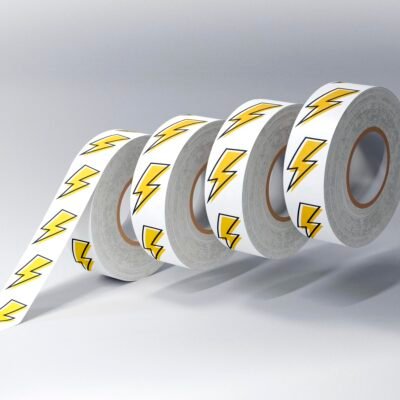
Sheet labels are often convenient for small, varied jobs applied by hand. Roll labels can improve dispensing and repeatability and may be required for a compatible applicator. The better format depends on the workflow, not just the order quantity. Our roll labels versus sheet labels comparison covers storage, hand application and production scaling in more detail.
For machine application, obtain the applicator’s requirements before ordering. Core size, maximum roll diameter, liner behavior and unwind direction can all affect whether the roll feeds correctly. There is no single winding direction that works for every machine.
Treat artwork versions as production components
Short runs make artwork changes easier, but they can also multiply file-management mistakes. Give every SKU a distinct filename and revision identifier. Check the dieline, bleed, safe area, small type and seam placement at final size. On clear or metallic material, determine where white ink is needed to preserve opacity and contrast.
If a launch also needs promotional seals or non-packaging graphics, a source for custom stickers and related printed pieces may support that separate part of the campaign. Keep the product-label specification tied to its own package and service conditions.
Barcodes and QR codes need more than a successful phone scan. GS1 calls the clear area around a 2D code the Quiet Zone and specifies different minimum clearances for Data Matrix and QR Code symbols. Contrast, substrate sheen, curvature, folds and the printing process can also affect performance. Use the applicable GS1 2D barcode guidance and arrange proper verification when the code participates in a retail or logistics system.
Keep print testing separate from regulatory approval
A short run can test whether a food label applies cleanly and remains readable, but it does not establish that the copy meets legal requirements. For FDA-regulated packaged food, the FDA identifies obligations under the Federal Food, Drug, and Cosmetic Act and the Fair Packaging and Labeling Act. It also states that it does not pre-approve food labels. Current FDA food-labeling guidance should be checked alongside the rules that apply to the product.
The same separation applies to cosmetics, alcohol, supplements, chemicals and other regulated products: the printer produces the specified label, while the responsible business must establish the correct content and compliance process. For food packaging, see our guide to separating material and print decisions from FDA requirements.
A practical short-run ordering checklist
- Use the exact production container and document its material, shape and usable label area.
- Describe refrigeration, freezing, condensation, oil, chemicals, abrasion, sunlight, heat and flexing that the label may encounter.
- Choose sheet or roll format according to hand or machine application, storage and repeatability.
- If using an applicator, provide its core, roll-diameter and unwind requirements.
- Proof every SKU at final size and check revision identifiers, small text, bleed and safe areas.
- Verify variable data for duplicates, sequence errors and readability.
- Apply samples under realistic conditions and inspect them after suitable dwell time.
- Test scanning with the actual package and workflow; obtain formal verification where the system requires it.
- Confirm current regulatory text through the relevant authority rather than treating a print proof as legal approval.
- Compare the total delivered cost, reorder time and obsolete-inventory risk before increasing the run.
Scale after the label system is stable
Short-run label printing wins when flexibility and risk reduction are worth more than the lowest theoretical unit price. Use the first batch to validate adhesion, durability, application speed, artwork and data—not merely to put a small quantity on the shelf. Once the package, demand and workflow are predictable, request pricing for larger quantities using the same tested specification. That is the point at which a longer production run can deliver savings without turning packaging inventory into a liability.