TLDR
The most important LOUPE Americas 2026 label trends are not isolated press features. They point toward connected packaging workflows: labels produced alongside flexible packaging or cartons, digital and conventional processes combined around the job, more automated administration, and tighter control of variable data, codes, color, finishing, and inspection. Buyers should evaluate these developments by the problem solved, the complete production system required, and the evidence a supplier can provide.
LOUPE Americas 2026 is scheduled for September 15–17 at the Donald E. Stephens Convention Center in Rosemont, Illinois. The official event scope covers labels, flexible packaging, folding cartons, materials, printing, finishing, inspection, application equipment, RFID and security solutions, and software. Because the event is still upcoming, that scope is best read as a map of industry priorities—not proof that every promoted technology will deliver lower costs or better results. View the official LOUPE Americas event information.
For a label buyer, the early answer is straightforward: labels are becoming part of a broader packaging, data, and production decision. A brand may still order an ordinary roll or sheet label, but the specification increasingly touches artwork versions, application equipment, inventory systems, connected identifiers, package structure, and automated quality control.
How to read the LOUPE Americas 2026 label trends
Start with five questions before considering a new press feature, smart-label system, or finishing effect:
- What surface must the label stick to?
- What environment will it experience?
- How will it be applied?
- How many labels and artwork versions are needed?
- What must the design communicate and survive?
These questions keep technology tied to the package. A digitally embellished label that wrinkles on a tapered bottle is not an improvement. An RFID inlay without dependable encoding and read points is not a traceability system. An automated workflow that accelerates the wrong artwork version simply creates errors faster.
The practical tradeoff remains appearance, durability, application speed, production format, and total cost. Buyers who are still establishing those basics can use this beginner’s guide to custom label printing before evaluating newer production options.
Labels are converging with other packaging formats
LOUPE’s expanded focus on labels, flexible packaging, and folding cartons signals that some converters are looking beyond a single pressure-sensitive product. The event’s announced programming includes discussion of inline folding-carton converting and what label converters should assess before diversifying into cartons.
For brands, convergence could mean discussing several packaging components with one production partner. It may also allow artwork, color expectations, version control, and scheduling to be coordinated across related items. Those benefits are possible, not automatic. Labels, pouches, and cartons involve different materials, converting steps, tolerances, filling conditions, and quality risks.
A buyer should therefore ask where each component is actually produced, who owns color and artwork coordination, and how changes move across formats. If a label revision also affects a carton panel or flexible package, the workflow should identify the dependent files rather than relying on someone to notice the mismatch manually.
Diversification will not make sense for every converter, either. New equipment requires suitable demand, operators, materials knowledge, quality controls, and finishing capacity. The meaningful trend is not that every label company will produce every package. It is that brands and converters increasingly need to understand how one packaging component affects the others. For broader context, see this overview of the label and packaging industry.
Digital, flexographic, and hybrid production will coexist
The useful question is not whether digital printing will replace flexography. It is which workflow fits the specific mix of run length, SKU count, version frequency, variable data, required finish, application method, and delivery schedule.
Digital production may be worth evaluating when a job contains many versions, frequent artwork changes, personalized or serialized information, or quantities that do not align neatly with a longer conventional run. Flexography may remain a strong fit for stable, repeat work when the construction, volume, and production setup support it. No universal quantity marks the dividing line; equipment, materials, finishing, waste, setup, and scheduling all affect the calculation.
Hybrid production combines process capabilities in one line or connected workflow, although suppliers may use “hybrid” differently. A buyer should ask exactly which operations are integrated. Does the system combine conventional and digital printing, or does it refer to printing followed by inline coating, embellishment, cutting, inspection, or another step?
The quotation should also separate press capability from actual job economics. Compare the same label construction, quantity, number of versions, finishing requirements, inspection level, freight basis, and expected reorder pattern. A faster press does not necessarily create a faster order if artwork approval, material availability, or offline finishing remains the bottleneck.
Automation matters most in the work between machines
Much of the industry’s automation opportunity sits in repetitive coordination: estimating, job intake, artwork routing, version control, scheduling, material allocation, production status, warehousing, shipping, and invoicing. CERM, for example, describes software connections across those functions, but these are vendor-reported capabilities rather than independent evidence of savings or error reduction.
AI claims need an even narrower evaluation. Ask which task the system performs and what information it uses. A tool that extracts job specifications, flags a missing file, predicts scheduling conflicts, or summarizes production data should be judged separately from a system that changes artwork or approves output.
Before adoption, document:
- The input data and how inaccurate or incomplete records are handled
- Which decisions are suggestions and which can trigger an action
- Who approves artwork, color, variable data, and production changes
- How exceptions are surfaced instead of silently passed downstream
- Whether activity is logged and can be audited
- How customer artwork, order data, and connected systems are secured
- Which measured result will determine whether the automation is useful
A credible demonstration should use a representative job with real versioning and exception handling—not only a perfect sample file. The goal is controlled throughput and fewer avoidable touches, not automation for its own sake.
Smart labels need a defined data problem
The official LOUPE schedule includes a session on RFID in smart and connected packaging, covering market context and real-world application. Its inclusion reflects growing attention to labels as data carriers as well as printed graphics.
QR codes and RFID should not be treated as interchangeable upgrades. A printed QR code is an optical symbol that a camera or scanner must see. It can direct a user or operator to digital information, but the destination, code contrast, print quality, placement, and ongoing management of the linked content all matter. RFID uses radio-based identification and requires suitable tags, encoding, readers, software, and process integration.
RFID may be appropriate when the operation needs automatic identification within a defined supply-chain, inventory, authentication, or traceability process. GS1 states that EPC/RFID can support automatic identification of consumer products through the supply chain. Its guidance also addresses consumer notice, choice, and privacy, which means implementation is partly a data-governance decision rather than only a print specification. Review GS1’s EPC/RFID guidelines.
Ask where the identifier is created, who encodes it, where it is verified, which partners can read it, and what happens when a tag fails. Package contents, label placement, stacking, and the intended read environment can affect system design. A converter should be able to explain verification and exception handling without implying that an RFID inlay alone creates visibility.
Linerless labels are a system choice, not just a material swap
A linerless construction does not use a separate release liner in the same way as a conventional pressure-sensitive roll. That difference affects printing, dispensing, cutting, adhesive handling, and equipment compatibility.
Avery Dennison describes direct-thermal linerless products with semi-permanent and removable adhesive options. It also states that linerless constructions require printers with appropriate release surfaces in the paper path. These are product-specific manufacturer statements, not evidence that any linerless stock will run through an existing printer or applicator.
Before considering linerless material, identify the printer model, cutter or dispensing method, roll dimensions, sensing requirements, adhesive behavior, application temperature, service conditions, and removal expectations. Test the full system with the actual substrate. Linerless may fit selected operational labeling workflows, but it should not be assigned universal cost or sustainability benefits without evidence for the exact construction and process.
Embellishment is growing alongside inspection and control
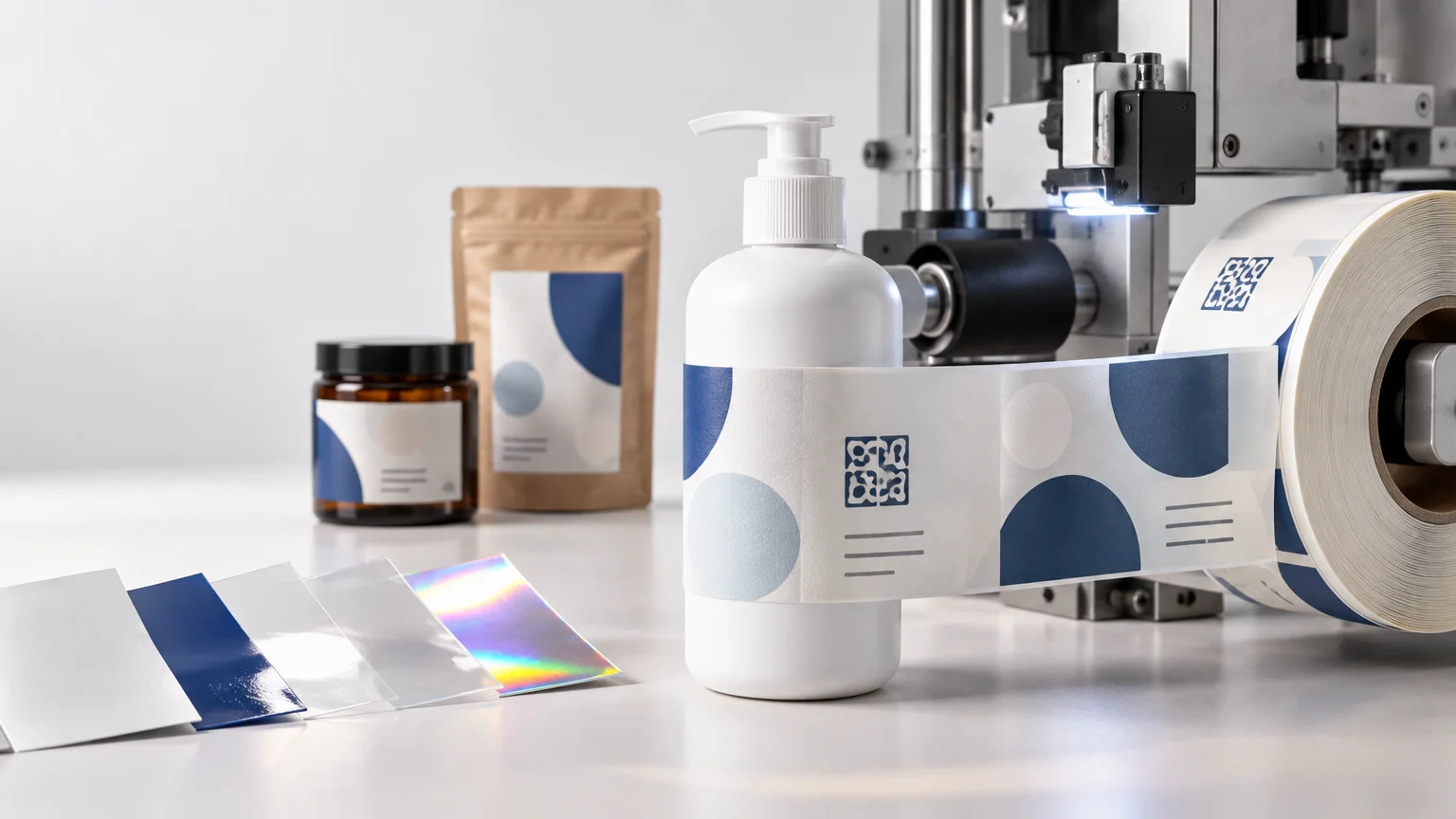
Digital embellishment can make it easier to place effects selectively or vary them between designs, but the buyer still needs to protect legibility and application performance. Foil-like effects, raised areas, opaque white ink, gloss contrast, or tactile elements should support the visual hierarchy rather than compete with required text, barcodes, QR codes, seams, or small-radius curves.
Finishing also has production consequences. Added coatings or decorative layers may change how a label flexes, winds, dispenses, or behaves during application. The relevant proof is not only an attractive flat sample. It is a finished label applied to the intended container and observed under realistic handling conditions.
As jobs carry more versions, variable data, embellishment, and connected identifiers, inspection becomes more important. The LOUPE event scope explicitly includes finishing, converting, inspection, RFID and security solutions, and application equipment. A supplier should be able to explain what is checked, at which production stage, and how rejected output is reconciled.
Useful questions include whether the workflow checks artwork version, color consistency, missing print, registration, die cutting, readable printed codes, variable-data sequence, and RFID encoding where applicable. Not every job needs the same inspection level, but the control plan should match the cost and consequence of an error.
What label buyers should do next
Do not begin with a technology name. Build a short specification around the package and the failure you need to prevent:
- Document the container material, surface texture, curvature, fill process, application temperature, and service environment.
- State whether labels will be applied by hand, a dispenser, or an automated applicator. For roll application, obtain the required roll dimensions, core, winding, and unwind direction from the equipment workflow.
- List quantities by SKU, expected reorder frequency, artwork changes, and any variable-data requirements.
- Identify the decorative effects and required information, then verify legibility at final size.
- Ask the supplier to define the production route, finishing steps, inspection method, and exception handling.
- Test production-representative samples on the actual package before committing to scale. The small-batch packaging test process provides a practical starting framework.
- Request measured evidence for claimed savings, automation results, read performance, or sustainability improvements instead of relying on broad marketing language.
For a conventional starting point, CustomLabels currently organizes offerings around roll and sheet formats and use categories such as business, food and beverage, event, home and address, variable-data, and kids labels. Available constructions and production details should still be checked on the current product page for the exact job. Compare current label categories and formats.
The practical takeaway
LOUPE Americas 2026 suggests that the future label will be evaluated as part of a connected system: package, artwork, press, finishing, application, inspection, identifier, and operational data. Digital and hybrid production, AI-assisted workflows, RFID, linerless materials, and digital embellishment can each be useful, but none is automatically the right upgrade.
The best next step is to choose one costly or persistent problem—slow version changes, application failures, manual job entry, unreadable codes, excessive handoffs, or weak traceability—and test a proposed solution against a representative job. If the supplier can define the inputs, controls, compatibility requirements, failure handling, and measurable outcome, the trend may be ready to become a practical production improvement.
References
- North America's largest dedicated label and package printing event | LOUPE 2026
- North America's largest dedicated label and package printing event | LOUPE 2026
- LOUPE Americas 2026 (formerly Labelexpo Americas) appoints ambassadors for key sectors | Loupe Global
- Events | CERM
- Event Schedule | LOUPE 2026
- GS1 guidelines on the use of EPC/RFID – Standards | GS1
- Linerless Labels | Avery Dennison | LPM
- Shop Labels – CustomLabels