TLDR
Plan food labels in two parallel tracks. The production track covers package geometry, surface, storage environment, application method, label construction and artwork. The compliance track determines which statements must appear, where they belong and which regulator has jurisdiction. A well-printed label is not automatically a compliant label, and a legally complete design can still wrinkle, lift or become unreadable if its physical specification is wrong.
Start with the filled production package rather than an empty design canvas. Ask five questions: What surface must the label stick to? What environment will it experience? How will it be applied? How many labels are needed? What must the design communicate and survive? Those answers should guide the size, material, adhesive, finish and supply format before artwork is finalized.
Start with the actual food package
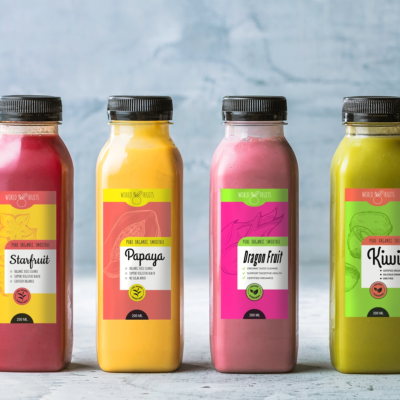
A jar, bottle, pouch and coffee bag do not present the same labeling problem. Glass may offer a smooth application surface, while a flexible pouch can bend and distort. A tapered bottle can force a rectangular label to wrinkle because its top and bottom edges must follow different circumferences. Paperboard, metal and plastic introduce their own surface and handling variables.
Measure the usable label panel on the final container. Keep the label away from abrupt shoulders, bottom curves, seams, ridges and other areas that prevent the facestock from lying flat. For a wraparound label, measure circumference and decide whether the ends should meet, leave a gap or overlap. The bottle and jar measurement guide explains how to identify the usable panel and test a proposed size with a paper mockup.
Choose the placement at the same time. A product might use one front label, separate front-and-back labels, a wraparound label, a lid label or a combination. Front-and-back labels create flexible placement but require two application steps. A wraparound label provides more continuous space but demands tighter control over alignment, taper and the location of the seam.
Plan the information before locking the label size
Do not select a small label and then attempt to squeeze required information into whatever space remains. Build a content inventory first. Separate branding and optional marketing copy from information that may be mandatory for the specific product.
For FDA-regulated packaged foods, the principal display panel is generally the part of the package most likely to be displayed or examined by consumers. The statement of identity and net quantity statement generally appear there. Other required information may appear on the principal display panel or an information panel, depending on the requirement and package. The FDA’s Food Labeling Guide provides the starting framework, although FDA notes that parts of the guide are not fully current and points readers to newer resources for subjects including allergens and Nutrition Facts labeling.
Create the regulatory content at realistic dimensions before approving the physical label size. If the ingredient statement, allergen declaration, business information, Nutrition Facts panel or other applicable copy cannot remain clear at final size, the answer may be a larger label, a second panel or different package architecture—not smaller type.
Choose sheets or rolls around the application process
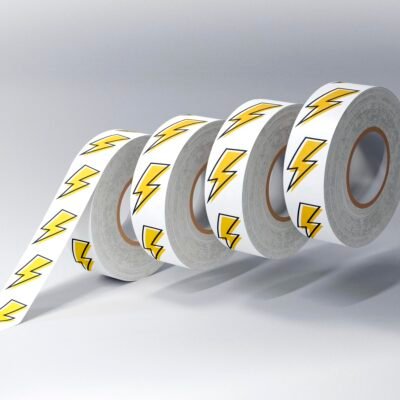
Sheet labels often work well for small batches, changing flavors and manual application. They are easy to store and divide among workstations. Roll labels become more practical when the same label is applied repeatedly, when a dispenser is used or when the operation moves to compatible application equipment. The detailed roll labels versus sheet labels comparison covers these workflow differences.
| Production situation | Likely starting format | Main issue to verify |
|---|---|---|
| Recipe testing or several short flavor runs | Sheets | Ease of separating versions and applying by hand |
| Repeated manual application | Rolls or sheets | Operator speed, storage and liner handling |
| Label dispenser | Rolls | Core size, roll diameter and dispensing direction |
| Compatible automatic applicator | Rolls | Unwind direction, core, gap, liner and equipment tolerances |
| Variable lot, date or code workflow | Depends on printing method | Space, readability and compatibility with the coding process |
There is no universal roll orientation. Before ordering for equipment, obtain the applicator manufacturer’s requirements for core size, maximum roll diameter, label gap, liner width, winding and unwind direction. A roll that contains the correct printed label can still be unusable if it feeds in the wrong orientation.
Match the label construction to real conditions
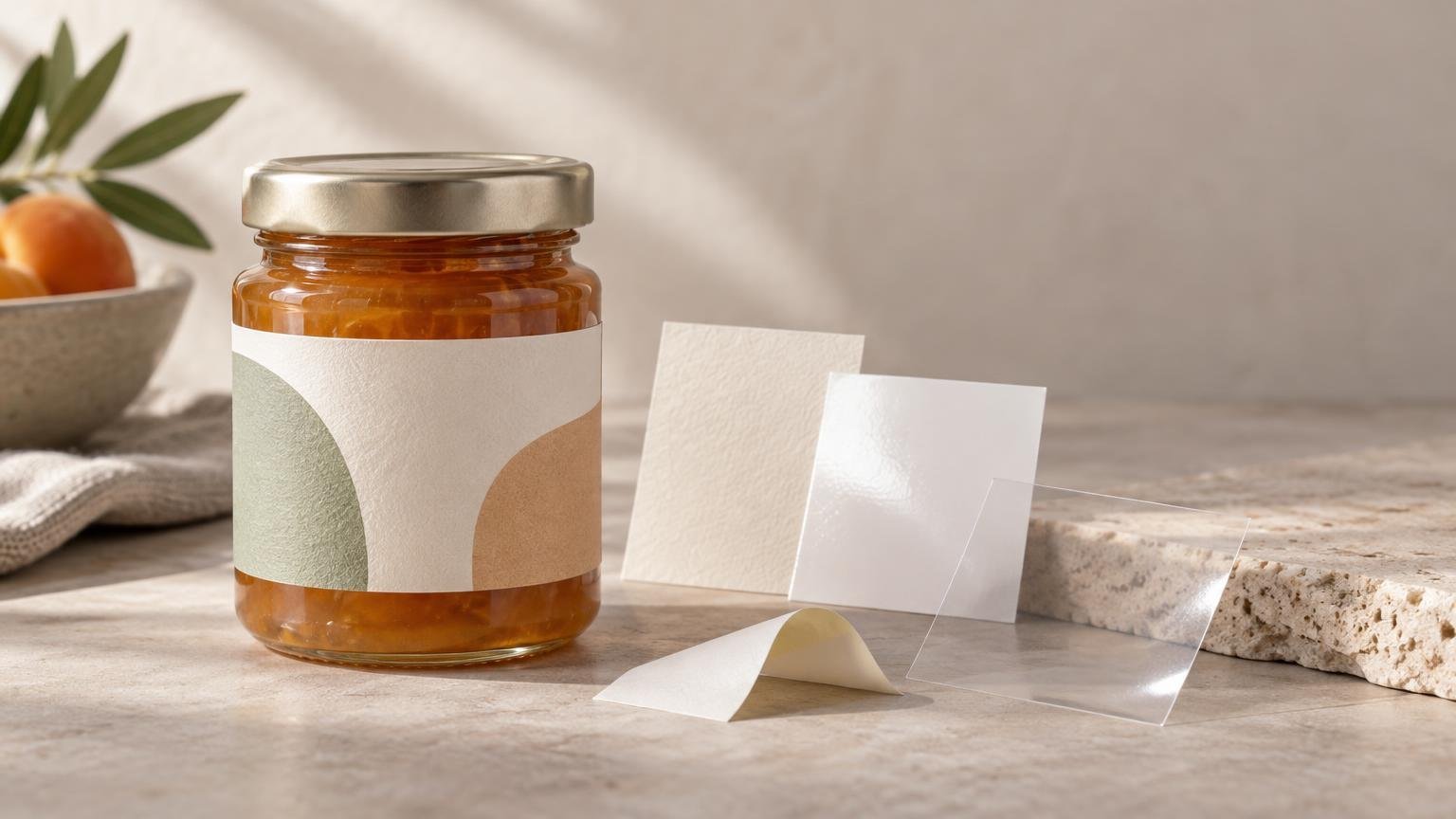
Material names alone do not determine performance. A pressure-sensitive label is a construction made from a printable facestock, adhesive and release liner, often with a protective laminate or varnish. The complete construction must suit the package surface, application temperature and service environment.
- Dry shelf-stable packages: Paper may be suitable when the package remains dry and receives limited abrasion, but confirm how it responds to spills and handling.
- Refrigerated bottles: Evaluate application temperature, condensation after filling, repeated handling and moisture during storage.
- Oily jars or flexible packages: Test whether oil reaches the label edges and whether the package flexes enough to stress the facestock or adhesive.
- Ice buckets and wet distribution: Require evidence for the exact construction and exposure period; do not treat “water-resistant” and “waterproof” as interchangeable.
- Clear containers: Plan contrast against both the product and the empty portion of the package. White ink may be needed behind selected artwork when offered for that construction.
- Freezer, heat or chemical exposure: Obtain documentation for the exact adhesive, facestock and finish under the expected conditions rather than relying on a broad material category.
As current first-party examples, CustomLabels describes its durable roll construction as BOPP with permanent adhesive and resistance to water, heat, UV, oil and abrasion. Its clear roll page describes transparent glossy and clear matte or frosted options, white-ink printing, permanent adhesion and indoor use. Its eco paper roll page describes short-term water resistance. These statements apply only to the products and configurations documented on those pages and should be reconfirmed when ordering.
That distinction matters. “BOPP” identifies a plastic film facestock; it does not, by itself, establish freezer performance, immersion resistance or compatibility with every plastic container. Likewise, a laminate can improve protection against abrasion or moisture without fixing an adhesive that is poorly matched to the surface.
Preflight food-label artwork at final size
Review the artwork on screen at its final physical dimensions and with a printed paper mockup. A design that looks spacious when enlarged may become crowded on a two-inch jar label. Keep important text and logos inside the printer’s safe area, extend backgrounds through the required bleed and avoid placing small copy next to a cut edge, package seam or strong curve.
For clear labels, inspect the design over the filled product—not just over a white screen. Dark sauce, pale dressing and an empty glass headspace create different backgrounds. Confirm whether white ink is available and specify where it should print. Without an opaque backing, colors and fine text may lose contrast.
Reserve intentional space for barcodes, QR codes, lot numbers, date codes or other variable information. Test the actual code at final size on the production material and curved package. The printing method used for later-added codes must also be compatible with the label surface and finish.
Food-label compliance requires a separate review
A printer can reproduce supplied artwork and may identify technical print problems, but a proof is not regulatory approval. Responsibility for determining the applicable rules remains separate from choosing a material, finish or format. If you also use custom stickers for shipping boxes or promotional inserts, treat those as a different production job rather than a substitute for the regulated package label.
For FDA-regulated foods, allergen and nutrition requirements deserve current, product-specific review. FDA identifies nine major food allergens: milk, egg, fish, Crustacean shellfish, tree nuts, peanuts, wheat, soybeans and sesame. Sesame became the ninth major allergen effective January 1, 2023.
The current Nutrition Facts format includes requirements addressing matters such as updated serving sizes, added sugars, vitamin D and potassium, along with calcium and iron declarations. Whether and how those rules apply must be determined for the particular product. A small-business or low-volume-product exemption may apply in limited circumstances, but it is not a blanket exemption from every food-label requirement. The existing guide to creating nutrition labels can help organize the production task, but current FDA resources should control regulatory decisions.
Jurisdiction also matters. USDA’s Food Safety and Inspection Service maintains separate labeling and label-approval resources for meat, poultry and certain egg products. Other product categories and sales channels can involve additional federal, state or local requirements. Confirm the regulatory path before final artwork approval rather than assuming every packaged food follows one standard FDA checklist.
Test before placing a larger order
Apply production-intent samples to filled, clean containers using the same process planned for the real run. A useful test should reproduce the relevant storage and handling conditions rather than merely checking whether the label sticks for an hour on an empty jar.
- Confirm that the label lies flat without bridging, wrinkling or lifting near curves and seams.
- Check alignment and application speed with the intended manual, dispenser or machine workflow.
- Refrigerate, chill, flex or handle the package as the product requires, then inspect the edges, print and finish.
- Read every panel at normal viewing distance and scan any barcode or QR code on the filled package.
- Verify that lot and date coding can be added cleanly if it occurs after label production.
- Complete a separate regulatory review of the final artwork, not an earlier draft.
A short pilot run can expose fit, workflow and durability problems before they are repeated across thousands of packages. The small-batch label testing guide provides a practical framework for testing packaging before scaling.
The next step
Specify food labels in this order: package geometry, information space, application workflow, environmental exposure, construction and final-size artwork. Then review the finished content under the rules that apply to the exact product and sales market. Before ordering, confirm current options on the label shop, obtain the precise material and roll specifications needed for production, and test the selected construction on filled packages. That process keeps print performance and regulatory compliance distinct while giving both the attention they require.
References
- How to Measure a Bottle for a Label Without Guessing – CustomLabels
- Guidance for Industry: Food Labeling Guide | FDA
- Food Labeling Guide
- Roll Labels vs Sheet Labels: Which Format Is Better for Your Business? – CustomLabels
- Durable Roll Labels – CustomLabels
- Clear Roll Labels – CustomLabels
- Eco Friendly Paper Roll Labels – CustomLabels
- Food Allergies | FDA
- Guidance for Industry: Questions and Answers Regarding Food Allergen Labeling (Edition 5) | FDA
- Changes to the Nutrition Facts Label | FDA
- Small Business Nutrition Labeling Exemption Guide | FDA
- Labeling and Label Approval | Food Safety and Inspection Service