The practical answer in the BOPP vs paper labels comparison is straightforward: choose BOPP when moisture, oils, repeated handling, or a clear film appearance are important. Choose paper when tactile character, an uncoated or textured look, or a straightforward dry-package application matters more. But do not order from that rule alone. BOPP and paper describe facestocks—the printable top layer—not the complete pressure-sensitive label.
According to Avery’s explanation of BOPP, BOPP is biaxially oriented polypropylene, a plastic film. Whether the finished label performs well also depends on its adhesive, liner, ink system, protective finish, package surface, application conditions, and service environment. A suitable facestock paired with the wrong adhesive can still lift, wrinkle, slide, or fail.
TLDR: Choose for the package, not the material name
- Choose BOPP as the starting point for bottles and containers exposed to condensation, splashes, oils, abrasion, or frequent handling.
- Choose paper as the starting point for dry packaging, boxes, jars, bags, short-lived promotions, or products that benefit from a natural, textured, or specialty-paper appearance.
- Do not assume every BOPP label is waterproof or every paper label is fragile. Adhesive, ink, laminate or varnish, surface, and exposure conditions change the result.
- Use a flexible construction for squeezable packages or compound curves; a relatively rigid film can wrinkle or lift when forced to move with the container.
- Test the finished label on the real package before scaling production.
Start with five questions
Before comparing swatches or quotes, define the actual labeling job:
- What surface must the label stick to—glass, metal, paperboard, or a particular plastic?
- What environment will it experience—dry shelves, refrigeration, condensation, oils, cleaning products, heat, sunlight, or abrasion?
- How will it be applied—by hand, with a dispenser, or through an automatic applicator?
- How many labels are needed, and will the design or variable information change between batches?
- What must the design communicate and survive, including small text, barcodes, transparent areas, and repeated handling?
These questions expose the real tradeoff among appearance, durability, application speed, production format, and total cost. They also prevent a common mistake: paying for a premium facestock while ignoring the adhesive or package geometry that actually causes failure.
BOPP vs paper labels at a glance
| Decision factor | BOPP label | Paper label |
|---|---|---|
| Moisture | Usually the stronger starting point, but performance depends on the complete construction | Can be coated or laminated for added protection; suitability varies by construction |
| Appearance | Available in clear, white, metallic, matte, and gloss film effects | Broad choice of coated, uncoated, textured, matte, gloss, metallized, and specialty looks |
| Container movement | Rigid BOPP is better suited to stable surfaces and simple curves than highly flexible packages | Paper generally favors rigid, relatively simple surfaces unless a specific construction is qualified |
| Abrasion and oils | Often selected for demanding handling, especially with a suitable print system or overlaminate | May need a protective laminate, varnish, or specialty facestock |
| Cost | Compare the quoted construction, run size, finish, and application losses | May be economical in some configurations, but specialty papers and protective finishes can change the comparison |
| Best starting uses | Beverage bottles, refrigerated products, bath products, oily foods, and frequently handled containers | Boxes, dry jars, bags, candles, event labels, address labels, and packaging where paper texture supports the design |
Moisture resistance is about the full construction
BOPP does not absorb water like an unprotected paper facestock, which makes it a logical candidate for chilled bottles, bathroom products, sauces, and other splash-prone packaging. That does not mean the word “BOPP” proves that every finished label will survive immersion, freezer cycling, outdoor exposure, or aggressive cleaning.
Application temperature and service temperature are separate specifications. A label might tolerate refrigeration after bonding but fail if it is applied to a cold, wet bottle. Surface energy, condensation, dust, container material, curvature, and adhesive dwell time can all affect the bond. For a closer treatment of this issue, see application temperature versus service temperature.
Paper is more varied than the phrase “paper label” suggests. The Avery Dennison paper materials technical guide covers coated, uncoated, grease-resistant, scuff-resistant, heat-tolerant, and other purpose-built paper facestocks. A laminate or coating can add protection, although exposed edges, cuts, and damaged areas may still allow moisture to reach the paper.
CustomLabels illustrates why product-level specifications matter. Its current Durable Roll Labels page describes a plastic-based BOPP construction with a permanent adhesive and attributes water, heat, UV, oil, and abrasion resistance to that named product. Its Paper Roll Labels page describes a 50 lb white stock with permanent adhesive, protective laminate, and abrasion resistance. Those claims apply to the specified products, not to all BOPP or all paper labels.
Appearance: film polish or paper character
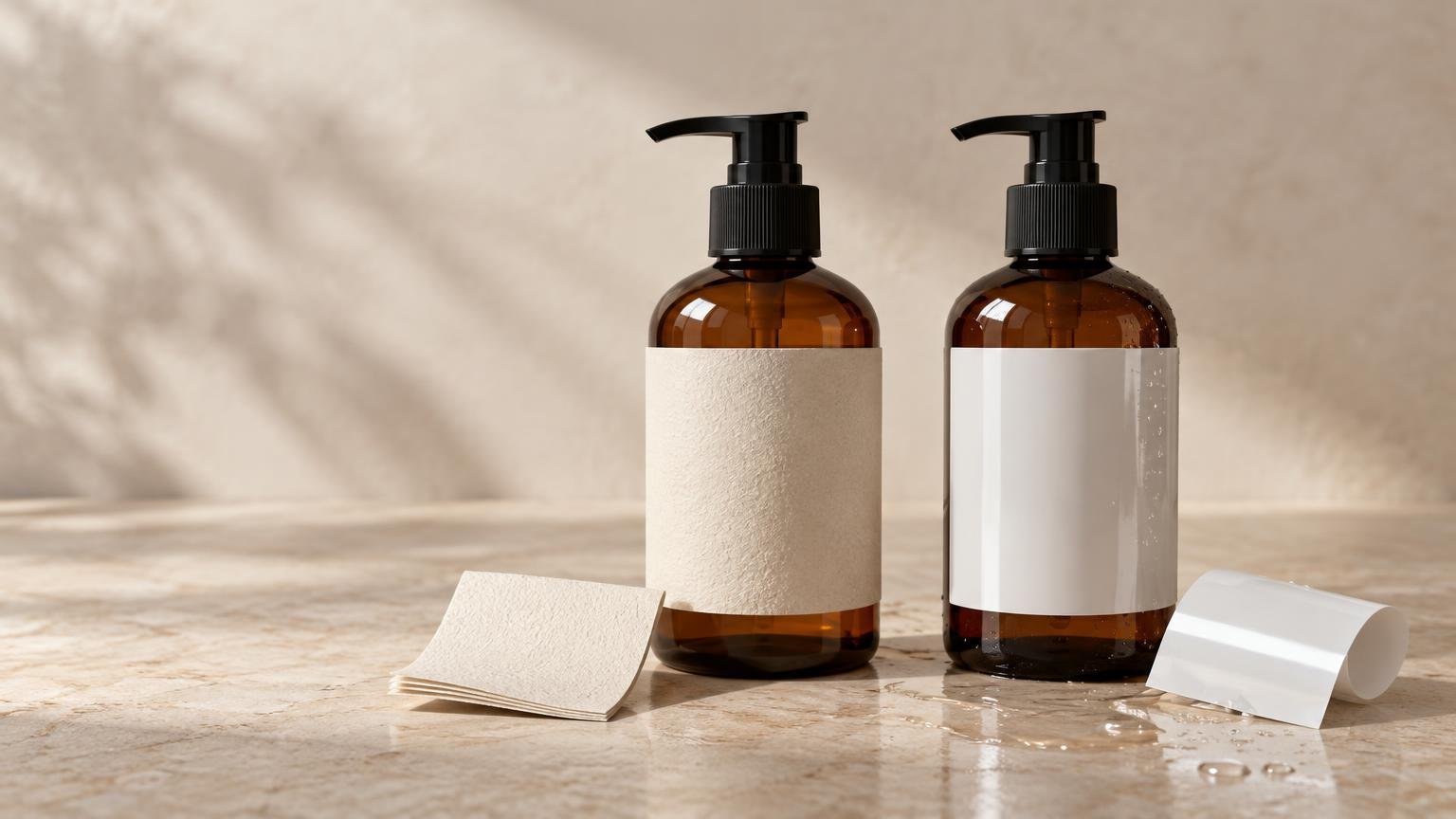
BOPP works well when the desired visual language is clean, bright, polished, or transparent. Clear BOPP can produce a near printed-on appearance because the package shows through the unprinted areas. White ink may be needed beneath pale colors, fine type, or a barcode so the product color does not reduce contrast. The choice between clear and white BOPP labels should therefore be made with the filled container in view, not from artwork on a white monitor background.
Paper offers a different design vocabulary. Smooth coated stock can look crisp and commercial, while uncoated or textured paper can reinforce a handmade, traditional, premium, or natural presentation. Specialty paper can also provide gloss, matte, metallized, or grease-resistant effects. Sustainability claims require more care: a paper facestock does not automatically make the complete label recyclable or compostable because adhesive, coating, ink, liner, and the labeled package all affect the outcome.
Cost depends on more than the facestock
Do not compare a basic paper label with a laminated, specialty-adhesive BOPP label and conclude that the difference is purely material cost. Request quotes for the same dimensions, shape, quantity, colors, finish, adhesive class, roll configuration, and delivery requirements.
Then consider total applied cost. A cheaper label becomes expensive if workers must slow down to control curl, replace damaged labels, wipe containers, or rework lifting edges. Conversely, a high-durability film may be unnecessary for a dry carton that is handled once and discarded. Specialty paper, metallic effects, laminate, custom dies, small orders, and multiple artwork versions can also narrow or reverse an expected price gap.
Format matters as well. Sheets can be convenient for small, varied, hand-applied batches. Rolls are generally easier to dispense and may be required by application equipment. If production is growing, compare roll labels and sheet labels before approving the material. For compatible roll products, obtain the required core size, maximum roll diameter, gap, liner, and unwind direction from the applicator or co-packer.
Match the material to the package shape
A smooth glass jar or straight-sided bottle gives either material a relatively predictable surface. Small-diameter tubes, tapered containers, flexible pouches, and squeeze bottles are harder. A rigid film can resist conforming to a compound curve or repeatedly moving with a squeezable wall. Industrial material guidance distinguishes rigid BOPP for flat surfaces and simple curves from more conformable films intended for shaped or squeezable containers.
Paper can also wrinkle, bridge, or lift when it is too stiff for the package geometry. Before changing materials, check label dimensions, grain and stiffness, adhesive, overlap placement, application pressure, and whether the container is full and at normal operating temperature during application.
Artwork and variable printing need separate checks
Material choice does not determine whether artwork is production-ready. Review type at final size, contrast, bleed, safe area, cut path, barcode quiet zones, and seams. Clear film requires special attention to white ink and show-through. Textured paper can soften tiny details or affect the appearance of fine lines, depending on the printing process.
For blank or variable-data labels, confirm the exact print technology. Paper constructions may be engineered for laser, inkjet, thermal-transfer, or direct-thermal printing, but those processes are not interchangeable. Likewise, do not assume a coated film will accept handwriting or a desktop printer simply because it is supplied blank.
Compliance is not established by choosing BOPP or paper
A durable facestock does not by itself establish food-contact suitability, FDA status, chemical-label compliance, or qualification for marine transport. Regulated applications may evaluate the facestock-and-adhesive combination, printing, adhesion, legibility, abrasion resistance, color fastness, and weathering. The Avery Dennison guidance on BS 5609, GHS, and IMDG labels demonstrates why compliance is construction-specific rather than a generic property of paper or BOPP.
Treat print production and legal compliance as separate workstreams. Obtain documentation for the exact construction, then confirm applicable labeling obligations with the relevant regulator, standard, or qualified adviser.
A practical sample-testing checklist
- Use the final container material, shape, surface treatment, and fill product.
- Apply labels at the actual packaging-line temperature, not only at room temperature.
- Clean containers using the intended production process and avoid touching the bond area.
- Allow the specified adhesive dwell time before judging the result.
- Expose samples to condensation, refrigeration, oils, abrasion, squeezing, transport, or cleaning conditions that reflect real use.
- Inspect edges, corners, seams, fine print, clear areas, and barcode readability.
- Test hand and machine application separately if both workflows will be used.
- Repeat the test across several containers rather than trusting one successful sample.
Small-batch sampling is cheaper than discovering a mismatch after a full production run. The guide to testing custom labels before scaling provides a broader packaging trial workflow. When comparing additional custom sticker, label, vinyl, and artwork-preparation choices, view options.
The final choice
Use BOPP as the leading candidate when the package will encounter moisture, oils, abrasion, refrigeration, or a design that benefits from clear film. Use paper when the environment is dry and the package benefits from paper texture, specialty finishes, or a traditional printed look. Then verify the adhesive, protective finish, flexibility, print process, roll format, and actual exposure conditions.
The best label is not the one with the most impressive material name. It is the complete construction that bonds to the real container, survives the real environment, runs through the intended application process, and keeps the artwork readable for the product’s useful life.
References
- Difference Between PET & BOPP | Avery
- Product Component Guide – ASEAN 2026
- Avery Dennison: Paper Materials Technical Guide
- Durable Roll Labels – CustomLabels
- Paper Roll Labels – CustomLabels
- Compare Industrial Label Materials | Avery Industrial™ | Avery.com
- BS 5609, GHS, and IMDG Compliant Labels Frequently Asked Questions | Avery Dennison | LPM