TLDR: choose according to the job, not the name
A packaging label is part of the product presentation and information system. It may identify the product, display required or useful details, carry a barcode, distinguish a variant, or provide directions. A promotional sticker usually leads with one campaign, logo, illustration, slogan, or giveaway message. The distinction is mainly functional: both can be pressure-sensitive printed pieces with adhesive and a release liner. Neither term guarantees a particular material, adhesive strength, finish, or durability.
Start with five questions: What surface must the piece stick to? What environment will it experience? How will it be applied? How many are needed? What must the design communicate and survive? Those answers determine whether you need a packaging label, a promotional sticker, or two separate pieces that each do one job well.
The practical difference between labels and promotional stickers
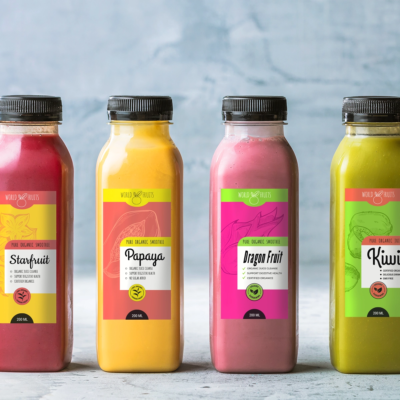
Packaging labels are designed around a product and its container. A sauce label must fit its bottle, remain legible through expected handling, and leave room for the information assigned to that panel. A cosmetic jar label may need small text to remain readable on a tight curve. An ecommerce shipping box may use a simple brand label, but that label still has to apply consistently to the box surface.
Promotional stickers are designed around distribution and visibility. They may be handed out at an event, included in an order, placed inside a subscription box, or used to support a limited campaign. The recipient, rather than the product packer, may decide where the sticker is applied. That changes the design brief: instant recognition and broad visual appeal often matter more than fitting a specific information architecture.
| Decision point | Packaging label | Promotional sticker |
|---|---|---|
| Primary role | Identify, explain, track, or support the sale and use of a product | Promote a brand, campaign, event, idea, or visual |
| Design priority | Information hierarchy, final-size legibility, package fit, and repeatability | Immediate visual impact and a self-contained message |
| Application | Usually applied to a known container by hand or equipment | Often distributed loose or applied to varied surfaces |
| Production format | Sheets or rolls selected around packing volume and application method | Cut singles or sticker sheets are common; rolls can suit campaign sealing or fulfillment |
| Testing focus | Container adhesion, service environment, scanning, and application consistency | Expected user surfaces, visual durability, handling, and clean release from the liner |
| Compliance role | May carry information governed by product-specific rules | Promotional claims still need to be truthful and supportable |
When the packaging label should do the work
Use a packaging label when the printed piece must remain associated with a specific product. Product identity, flavor or scent, size, lot information, directions, warnings, ingredients, business information, and machine-readable codes may all belong in the package’s label system. The exact requirements depend on the product and jurisdiction; the printer does not decide which statements are legally required.
For packaged foods in the United States, federal rules define the principal display panel as the part of the package most likely to be displayed or examined under normal retail conditions. The statement of identity belongs on that panel, while other mandatory information is subject to additional placement rules. The current Code of Federal Regulations for food labeling provides the governing details.
Cosmetics have their own framework. The FDA summary of cosmetics labeling requirements explains that the principal display panel generally carries product identity and an accurate net-quantity declaration, while ingredients, company information, warnings, and directions may appear on information panels as applicable. A good proof can confirm spelling, placement, color, and cut position, but it does not establish regulatory compliance.
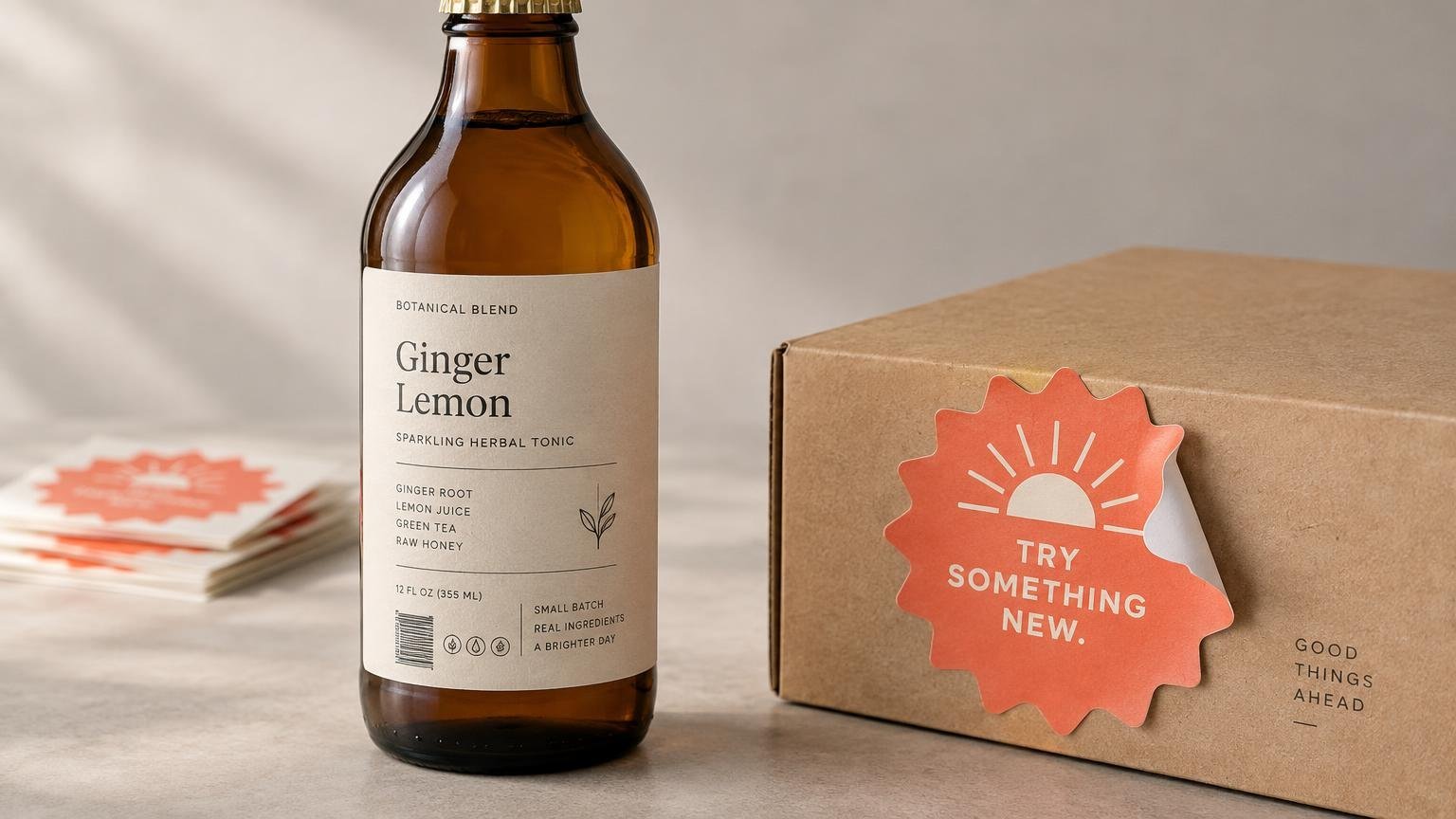
If the package needs both required information and a bold campaign message, do not force everything into one crowded layout. A stable primary label can carry the product information, while a separate promotional seal or sticker highlights a launch, seasonal message, or event. For more detail on the information role, see what a product label does.
When a separate promotional sticker is the better tool
Choose a promotional sticker when the message needs to travel independently of the package. This works well for order inserts, event giveaways, loyalty rewards, launch kits, and branded extras. It also allows one standard box, bag, or mailer to support several short campaigns without redesigning the complete product label.
The sticker should still have a defined use case. A handout intended for notebooks has a different performance target from a campaign sticker expected to appear on bottles, helmets, windows, or outdoor equipment. Decide whether it needs a paper or film facestock, permanent or removable adhesive, a clear or opaque appearance, and a protective finish. For sticker-printing purchases involving vinyl, clear, holographic, die-cut, or sheet formats, customstickers.com is a relevant ordering route.
Promotional does not mean exempt from advertising rules. The Federal Trade Commission states that advertising claims must be truthful, non-deceptive, fair, and supported by evidence. That applies whether a claim appears on the main package label, a neck seal, or a separate campaign sticker. FTC advertising and marketing guidance is the appropriate starting point for federal advertising principles.
Specify the surface before choosing the material
Material names are only the beginning. The complete construction includes the printed facestock, adhesive, ink system, protective laminate or varnish when used, and liner. Its performance depends on the actual surface and conditions. Glass, coated paperboard, metal, and common plastics do not present the same adhesion problem. Texture, contamination, small diameters, tight curves, and low-surface-energy plastics can all change the result. Adhesive bond strength may also build after application rather than reaching its final level immediately.
The Avery Dennison product-selection considerations identify low-surface-energy materials, textured surfaces, and tight curves as conditions that may require different facestock or adhesive choices. Clean, dry application surfaces also matter because dust, oil, grease, and moisture can interfere with contact between adhesive and container.
For packaging, test on the filled or production-equivalent container whenever possible. Condensation can appear only after a chilled bottle returns to a warmer room. Oils may migrate onto a food jar or cosmetic container during filling. A flexible pouch may wrinkle a stiff label as it bends. A tapered bottle can make a large rectangular label crease even when the adhesive itself is suitable.
Appearance cannot substitute for this test. Gloss describes the visual finish, not a universal resistance level. Clear material does not automatically suit wet service. Vinyl does not guarantee adhesion to every plastic. Match claims such as water-resistant, freezer-safe, outdoor-durable, or chemical-resistant to the exact construction and its documented conditions.
Choose the format around application and quantity
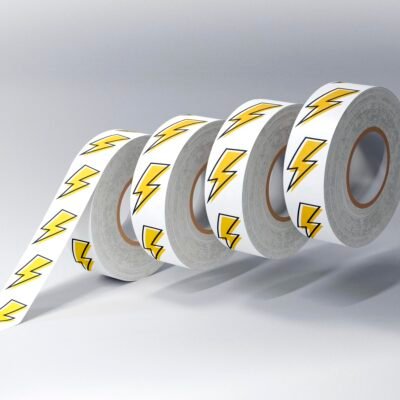
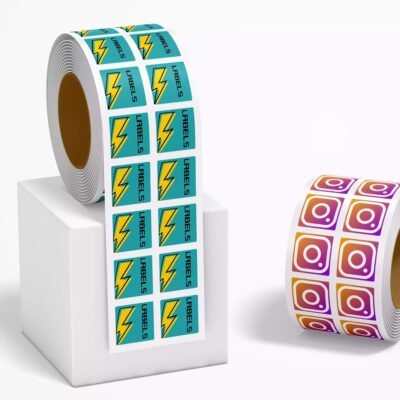
Sheet labels are often convenient for small, varied batches applied by hand. Rolls can support faster dispensing, more repeatable hand application, and machine workflows. Cut singles are particularly natural for promotional giveaways because each sticker can be distributed separately. These are workflow choices rather than strict definitions of labels and stickers.
If an applicator will be used, ask the equipment operator for the required core size, maximum roll diameter, gap between labels, liner specification, and unwind direction. There is no universal roll orientation. The correct direction depends on which label edge must dispense first and how the package moves through the machine. A small trial can expose orientation, liner, or sensor problems before a full run is produced.
Quantity affects the sensible format as well. A launch team hand-applying several product variants may value flexible sheets and easy sorting. A fulfillment line applying thousands of identical labels may value rolls, consistent winding, and predictable liner behavior. Brands still validating the package can use small-batch label testing before scaling to check fit and performance without treating the first artwork version as final.
Design the information hierarchy at final size
A packaging label must usually communicate more than a promotional sticker, so hierarchy matters. Establish the product identity first, then organize variant details, quantity, directions, warnings, claims, business information, and codes as applicable. Review the artwork at its actual printed dimensions. Text that looks comfortable on a large monitor can become difficult to read on a two-inch container.
Keep critical text and logos inside the safe area, extend background artwork through the bleed, and inspect where the label seam or overlap will fall. Clear and metallic materials may need white ink beneath selected elements to control transparency and color appearance. On curved containers, avoid placing small text or critical codes where the surface turns sharply away from the viewer.
Barcodes require more than visual resemblance to a sample. GS1 advises checking quiet zones, contrast, colors, symbol dimensions, print damage, wrapping, and placement on cylindrical items. GS1 barcode quality guidance explains these variables in more detail. A QR code can support instructions, campaign content, or product information, but GS1 states that a GS1 QR Code does not replace an EAN or UPC where that retail barcode is required.
A practical ordering and testing checklist
- Define the role. List everything the packaging label must communicate, then separate any optional campaign message that could work better as a promotional sticker.
- Identify the substrate. Record the container material, texture, coating, curvature, seams, and any low-surface-energy plastic rather than ordering from appearance alone.
- Map the environment. Include application temperature, refrigeration, condensation, oil, chemicals, abrasion, sunlight, heat, squeezing, and storage time.
- Choose the workflow. Decide whether labels will be applied by hand, with a dispenser, or by machine. Obtain roll and liner requirements directly from the equipment workflow.
- Build artwork at final size. Check small type, contrast, bleed, safe area, cut path, white ink, and the position of seams and overlaps.
- Verify regulated content separately. Use the authority responsible for the product category and market; do not treat a print proof as legal approval.
- Test production-equivalent samples. Apply them to clean containers, allow appropriate dwell time, and expose them to the real handling and service conditions.
- Scale only after the test. Confirm adhesion, readability, scanning, dispensing, and pack-line speed before committing to the larger run.
The best answer is often to use both
Packaging labels and promotional stickers are not rival names for the same purchasing decision. The packaging label should fit the container, survive the expected environment, apply reliably, and communicate the product information assigned to it. The promotional sticker should deliver one memorable message in a format suited to distribution or campaign use.
Use one piece when the information and promotional jobs fit together cleanly. Use two when combining them would produce cramped type, weak hierarchy, frequent packaging revisions, or a giveaway that only makes sense while attached to the product. Specify each from its surface, environment, application method, quantity, and communication task. That approach produces a better label system than choosing by gloss, shape, or the word printed on the quote.
References
- High Quality Custom Labels – Fast and Free Shipping
- Code of Federal Regulations
- Summary of Cosmetics Labeling Requirements | FDA
- Advertising and Marketing | Federal Trade Commission
- Product Selection Considerations
- How to Apply Your Labels Perfectly | Avery
- Short-Run Label Printing: When Small Batches Win
- What should I check to ensure good quality barcodes? : GS1 GO Customer Service Portal
- Does the GS1 QR Code replace EAN or UPC barcodes? : GS1 GO Customer Service Portal