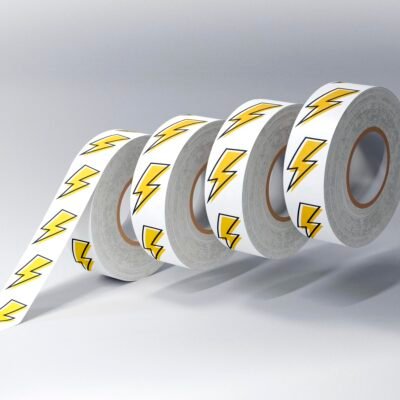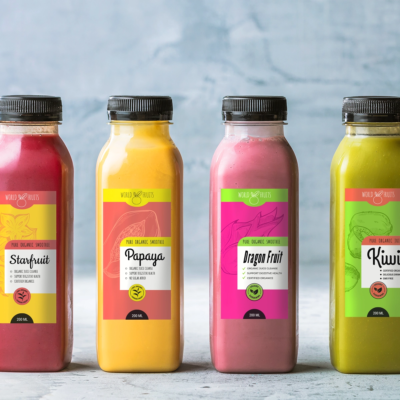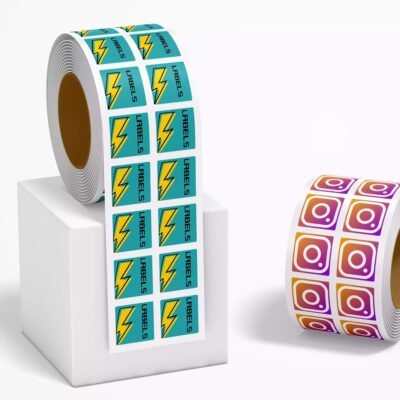
TLDR: Match the complete label construction to the job
Choose a label by answering five questions: What surface must it stick to? What environment will it experience? How will it be applied? How many labels are needed? What must the design communicate and survive? Paper can work for dry, controlled conditions, while film is often the stronger starting point for moisture, oil, flexing, abrasion, or prolonged outdoor exposure. The final choice still depends on the adhesive and protective finish—not just the visible material.
A pressure-sensitive label is a system made from printable facestock, adhesive, and a release liner. Laminate or varnish may add another protective layer. Specifying only “water-resistant material” leaves several failure points unresolved: the adhesive may lift, the ink may scuff, or a stiff facestock may spring away from a curved bottle. Avery Dennison’s label construction guidance illustrates why the complete construction matters.
Start with the package, not a material name
Record the package substrate first: glass, metal, coated paperboard, flexible film, or a particular plastic. Smooth glass is a different bonding surface from textured plastic. Polyethylene and polypropylene containers can also be difficult because they have relatively low surface energy, which makes it harder for an adhesive to wet out and form a reliable bond.
Geometry matters as much as chemistry. A rigid label that looks excellent on a flat carton may lift at the edges when wrapped around a narrow tube. Tapered bottles and compound curves can produce wrinkles because a flat label is being forced across a changing diameter. Avery Dennison notes that curved surfaces under 25 mm in diameter may require a more aggressive adhesive and a flexible, low-memory facestock.
Clean the test containers using the same process planned for production. Dust, oil, mold-release residue, condensation, and cleaning chemicals can all interfere with bonding. Apply test labels at the real application temperature, then allow time for adhesion to develop before judging them. Application temperature and service temperature are separate specifications: a label might survive refrigeration after bonding but fail if it is initially applied to an already cold, wet bottle.
Choose the facestock for the exposure
| Condition | Useful starting point | What to verify |
|---|---|---|
| Dry indoor packaging | Paper | Scuffing, staining, storage humidity, and whether the package will ever be chilled |
| Condensation or frequent splashes | PP/BOPP film or an appropriate wet-strength paper | Adhesive performance on a wet or chilled package and protection for the printed image |
| Oily products | Film with a compatible adhesive and protective finish | Exposure at the label edge, oil migration, ink resistance, and cleaning chemicals |
| Squeezable containers | Flexible PE film or another conformable construction | Wrinkling, edge lift, repeated flexing, and compatibility with the container plastic |
| Cold or frozen service | Construction rated for the actual application and service temperatures | Whether labels are applied before or after chilling, condensation, dwell time, and freezer cycling |
| Outdoor exposure | Durable film with a suitable adhesive and protective overlaminate | UV exposure, rain, abrasion, temperature swings, and required service life |
Paper for dry conditions—and selected wet applications
Standard paper is usually best reserved for relatively dry, controlled environments. It can absorb moisture, weaken, stain, or wrinkle when repeatedly exposed to condensation. Wet-strength paper is a separate category designed to better preserve its structure and bond performance in damp, refrigerated, or wet conditions when paired with a suitable adhesive. UPM’s paper label overview explains this distinction.
Wet-strength paper can preserve a textured or traditional paper appearance, but it should not be treated as interchangeable with film. Test the printed label through the full moisture cycle, including refrigeration, condensation, wiping, and drying.
Film for moisture, oil, flexing, and harder service
PP or BOPP film provides dimensional stability, printability, moisture resistance, and broad chemical resistance. It is a common starting point for bottles, jars, and other rigid packaging exposed to splashes or condensation. PE film is more flexible, making it useful for squeezable tubes, bottles, and pouches. PET is generally positioned for demanding applications involving sustained chemical exposure, heat, abrasion, or industrial conditions. UPM’s film material guide provides a useful comparison of these film families.
Those broad categories are only a shortlist. A film label can still fail if the adhesive is wrong for the plastic, the container flexes more than expected, or oil reaches the adhesive through exposed edges.
Match the adhesive to temperature, surface, and handling
Adhesive selection starts with whether the label should remain permanently attached or be removable, but that is only the beginning. Ask the converter for the minimum application temperature, service-temperature range, recommended substrates, and any limitations involving moisture, oil, chemicals, or rough surfaces.
For cold products, map the actual workflow. A sauce bottle labeled at room temperature and refrigerated later presents a different challenge from a beverage bottle labeled after chilling. For outdoor use, account for heat, cold, rain, ultraviolet exposure, and repeated thermal cycling. “Permanent” describes the intended bond behavior; it does not automatically establish outdoor durability on every surface.
Order a small trial when the package or environment is unfamiliar. The guidance in this small-batch packaging test guide can help structure that evaluation before a larger production run.
Use laminate or varnish to protect the printed surface
Facestock and finish are different decisions. The facestock is the main printable material; a laminate is a clear film placed over the print, while varnish is a liquid coating. Either may affect appearance and resistance to rubbing, moisture, oils, or cleaners, but performance depends on the exact construction.
Gloss, matte, holographic, and clear describe visual choices as well as production considerations. Clear film can create a no-label appearance, but the product and container color become part of the design. Metallic and reflective surfaces can also change contrast. Compare the visual tradeoffs in the guide to matte, gloss, holographic, and clear labels, then verify durability separately.
For jobs that are closer to custom stickers or vinyl graphics than packaging labels, customstickers.com is a relevant place to compare formats.
Protect barcodes and QR codes from the environment
A label has not succeeded if it remains attached but its code stops scanning. Barcode and QR performance depends on contrast, quiet zones, symbol size, placement, print quality, packaging interference, and deterioration. GS1 recommends testing 2D codes on the final production substrate and package, while avoiding folds, seams, cut lines, and highly curved areas. Reflective finishes can impair scanning. GS1’s barcode quality guidance provides a practical inspection framework.
Scan samples before exposure and again after refrigeration, condensation, abrasion, oil contact, or outdoor aging. Use the actual scanners and phones expected in the workflow rather than relying only on a clean digital proof.
Run a realistic qualification test before scaling
- Apply labels to production containers, not substitute jars or test panels.
- Use the planned cleaning method and application temperature.
- Test multiple locations on curved, tapered, or squeezable packages.
- Allow the recommended dwell time before beginning exposure tests.
- Recreate refrigeration, condensation, oil, cleaning, abrasion, sunlight, and handling conditions.
- Inspect for edge lift, tunneling, wrinkles, ink damage, staining, adhesive ooze, and loss of scan performance.
- Repeat the test across multiple containers and production batches before approving a large run.
If labels will be machine applied, obtain the applicator’s requirements for roll orientation, core size, dispense direction, label gap, liner, and maximum roll dimensions. Material durability does not guarantee that a roll will feed or dispense correctly.
For food packaging, print performance and regulatory compliance remain separate questions. The FDA describes food-contact substances broadly enough to include packaging components and materials applied to packaging surfaces, including adhesives and colorants. Confirm the intended use and applicable requirements with the relevant supplier and regulatory authority; a printer’s durability recommendation does not determine legal compliance. FDA food-packaging information is a useful starting point.
The practical choice
References
- Avery Dennison
- Product Selection Considerations
- Product Component Guide – ASEAN 2020
- Paper labels | UPM Adhesive Materials
- Film label materials | UPM Adhesive Materials
- What should I check to ensure good quality barcodes? : GS1 GO Customer Service Portal
- Guide
- Do barcodes have to be printed at the nominal size? : GS1 GO Customer Service Portal
- Food Packaging & Other Substances that Come in Contact with Food – Information for Consumers | FDA