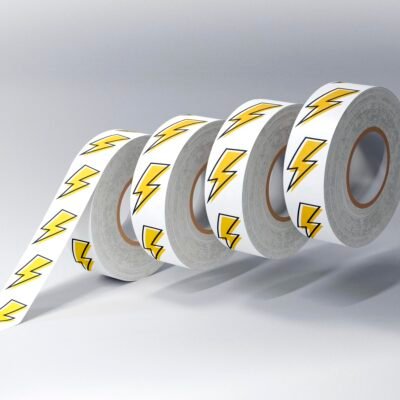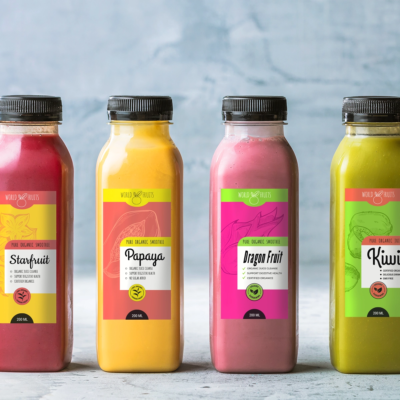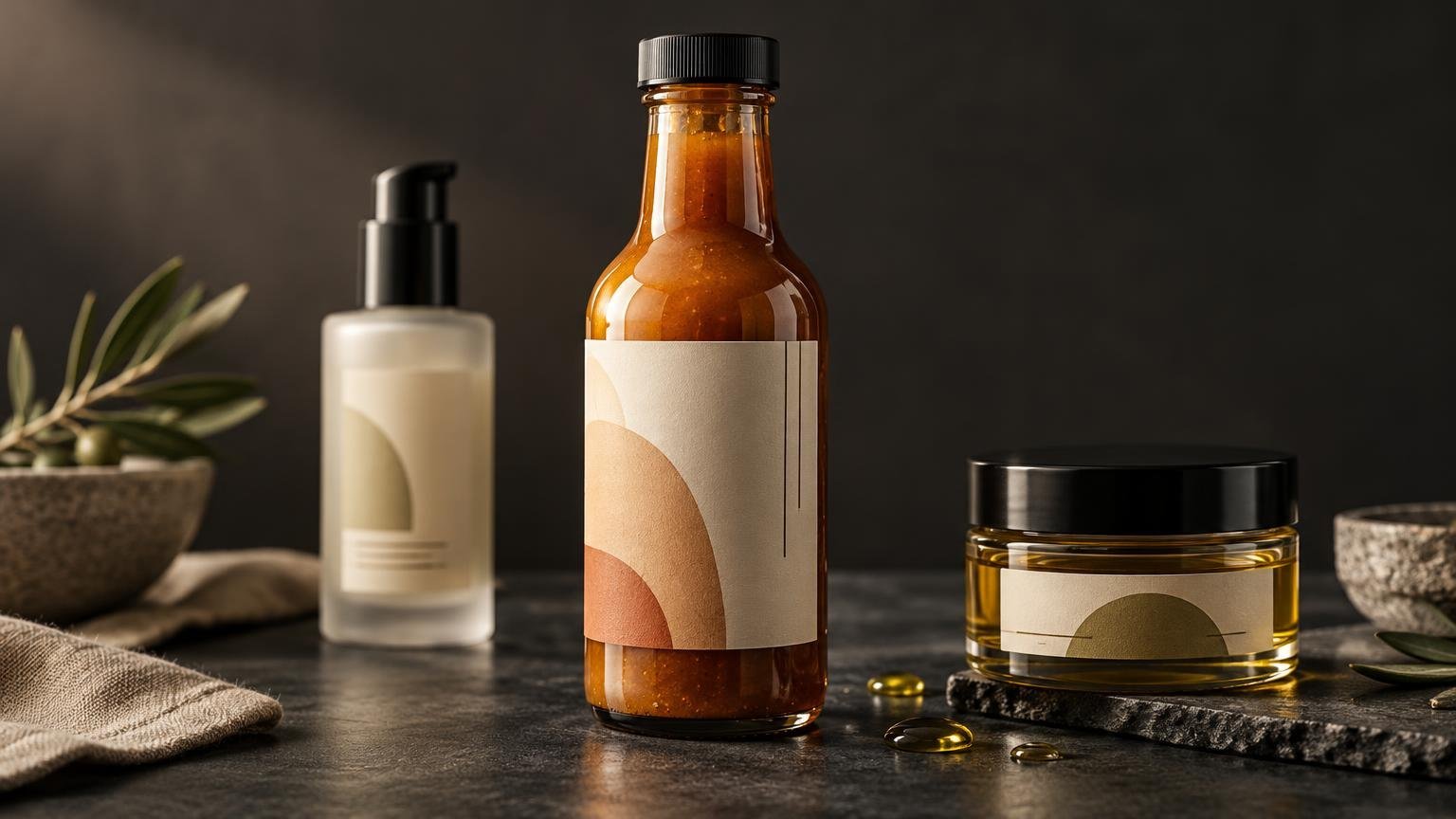
Oil-resistant labels need a construction that keeps the printed surface legible and the label attached when oil reaches the package. For many sauces, cosmetics and oily household products, a film facestock such as BOPP is a sensible starting point. It is not the whole specification. The adhesive, ink system, protective finish, container surface, application conditions and duration of exposure all affect the result.
A label that survives a few greasy fingerprints may still stain, soften or lift when oil repeatedly runs down a bottle. A construction that bonds well to clean glass may behave differently on an HDPE squeeze bottle. The useful question is not simply, “Is this label oil-resistant?” It is, “Which parts of this label have been tested against the oil exposure and package conditions my product creates?”
TLDR: Specify the complete label, not an oil-resistant material
Start with five questions: What surface must the label stick to? What environment will it experience? How will it be applied? How many labels are needed? What must the design communicate and survive? Then balance appearance, durability, application speed, production format and cost.
Film labels are usually a stronger starting point than unprotected paper when packages face oil, moisture, frequent handling or abrasion. Even so, “film” and “oil-resistant” do not define the adhesive, exposure duration, temperature range or protection over the printing. Compare the complete construction, test it on filled production containers and inspect both the label face and its edges before ordering at scale. The broader BOPP versus paper label comparison explains the main material tradeoffs.
Define what oil exposure actually means
Oil exposure is not one condition. A sauce bottle may receive occasional drips around the neck, repeated wiping during use and refrigeration after opening. A facial-oil bottle may be handled with product-coated fingers every day. A workshop container may encounter lubricants, cleaners and abrasion. Those scenarios place different demands on the printed surface and adhesive bond.
| Exposure | Likely failure to watch for | Specification priority |
|---|---|---|
| Oily fingerprints | Smudging, gloss changes or loss of fine text | Protected print surface and abrasion resistance |
| Sauce drips down a bottle | Staining, edge penetration or lifting | Film facestock, protected printing and sealed-looking edges |
| Repeated handling and wiping | Scuffing, fading or gradual edge lift | Durable finish, good adhesive contact and practical label geometry |
| Flexible or squeezable package | Wrinkles, tunneling or corners lifting | Conformable construction and a shape that can flex |
| Oily residue on the container before labeling | Weak initial bond or labels sliding | Clean application surface, suitable adhesive and firm pressure |
| Long contact with aggressive fluids | Swelling, delamination or print damage | Application-specific chemical testing rather than a general oil claim |
Technical data should distinguish light contamination from prolonged contact, immersion or exposure to aggressive fluids. One 3M durable-label material data sheet, for example, treats bonding to slightly oily metal, chemical resistance, application temperature and service temperature as separate considerations. It also reports adhesion under defined conditions on particular substrates and directs users to evaluate suitability for their application. That is the right way to interpret an oil-resistance claim: as the beginning of qualification, not a universal guarantee.
Choose the facestock and finish together
Facestock is the printable material forming the visible body of the label. BOPP, a polypropylene film, is commonly considered for oily, wet and abrasion-prone packaging because it does not absorb liquids like unprotected paper. CustomLabels presents BOPP as a usual starting point for these environments while emphasizing that performance depends on the full construction. Not every BOPP label is automatically waterproof or suitable for every oil.
Paper can still be appropriate when the desired look, short service life or protected environment matters more than maximum resistance. A coating or laminate can shield the printed face, but exposed paper edges remain potential entry points. Oil creeping beneath an edge can discolor the paper or interfere with the bond. A paper label that looks good in a dry display test therefore should not be assumed to suit a sauce bottle or an oily cosmetic container.
The current CustomLabels Durable Roll Labels page describes a plastic-based BOPP construction with permanent adhesive and claims resistance to oil, water, abrasion, heat and UV fading. The visible product copy does not provide an oil type, exposure duration, test method, adhesive chemistry or compliance certification, so those details should be confirmed for any demanding application. By comparison, the current Paper Roll Labels page describes laminated paper and abrasion resistance but does not state an oil-resistance claim.
Finish affects both protection and appearance. Gloss can make colors look more saturated and is generally easy to wipe, while matte can reduce glare and create a softer presentation. Neither look proves a particular resistance level. Ask whether the protective layer covers the printed image, how the edges are finished and whether the ink-and-finish combination has been evaluated against the actual product.
Match the adhesive to the container
The label face can remain pristine while the adhesive fails underneath it. Glass and PET are often comparatively favorable surfaces for pressure-sensitive labels. Plastics with lower surface energy, including many HDPE containers, can be harder to bond. Dust, mold-release residue, moisture and oil already on the package can further reduce adhesive contact.
This distinction matters for oily products because the oil may come from either side of the label. Product can run onto the label during use, but filling operations can also leave a thin residue on the container before labeling. An adhesive described as permanent cannot compensate for a contaminated surface it never properly contacts.
Apply test labels to containers prepared through the real production process. If bottles are washed, filled, capped, chilled and then labeled, reproduce that sequence. Use the intended application pressure and allow the specified dwell time before beginning exposure tests. Applying a label to a cold, wet bottle is different from applying it warm and dry and refrigerating it after the bond develops. The guide to application temperature versus service temperature explains why those stages should be evaluated separately.
Account for shape, flexing and label edges
A flat glass jar is relatively forgiving. Small-diameter cosmetic tubes, tapered sauce bottles, flexible pouches and squeezable containers are not. Their geometry can place constant stress on label edges or force the facestock to flex whenever the package is used. Oil can then exploit an edge that has already started to lift.
Measure the actual labeling panel rather than relying only on the container’s nominal dimensions. Avoid pushing a stiff label into compound curves. Rounded corners can reduce snagging, while a narrower label may conform better than an oversized wrap. On a squeeze bottle, test whether repeated flexing causes wrinkles or tunnels. On a tapered bottle, look for a fan-shaped wrinkle pattern that indicates the label shape does not match the container.
Seams deserve particular attention on wraparound labels. Place the overlap away from the most frequent drip path when the package design permits. After exposure, inspect the seam, leading and trailing edges, corners and any area customers grip during use.
Design artwork to remain readable after handling
Oil resistance is useful only if the label still communicates. Evaluate artwork at final printed size, including small ingredient text, directions, lot information and warnings. Maintain adequate contrast, keep critical copy inside the safe area and extend backgrounds through the required bleed so small cutting variation does not create unwanted white edges.
Clear film adds another variable: the color and opacity of the product become part of the design. Pale type can disappear against a light sauce, oil or lotion. White ink beneath text, graphics or a barcode can create a controlled opaque base. The choice between transparent and opaque material is covered in more detail in the guide to clear versus white BOPP labels.
Barcodes and QR codes need stable contrast and clear surrounding space. Put them on the flattest practical part of the package, away from a seam, tight curve or area that receives frequent oily drips. Scan codes from filled packages before and after handling tests. A code that works on a clean digital proof may fail once glare, curvature, product color, scuffing and oil are introduced.
Choose sheets or rolls for the application workflow
Sheet and roll formats do not determine oil resistance by themselves. The construction does. Sheets often work well for small quantities, varied designs and hand application. Rolls are usually more convenient for repeated production, dispensers or compatible automatic and semi-automatic applicators.
A maker labeling 100 sauce jars by hand may value sheets or manageable rolls and easy design changes. A cosmetics operation labeling thousands of identical bottles may need rolls specified for its equipment. In the latter case, confirm core size, maximum roll diameter, label gap, liner behavior, unwind direction and artwork orientation before production. The roll versus sheet label guide provides a fuller workflow comparison.
For jobs that are primarily decorative stickers rather than package labels engineered around oil exposure, CustomStickers provides custom sticker, vinyl and artwork-preparation options. Keep the distinction clear: a sticker material chosen for general outdoor or decorative use is not automatically qualified for prolonged contact with a particular oil or chemical.
Test the filled package before scaling
A useful test uses the real container, real product and real handling cycle. Empty-package testing can miss oil migration around caps, drips caused by pouring, bottle flexing and condensation after refrigeration. It can also miss interactions between a clear label and the color of the contents.
- Clean and prepare containers exactly as production will prepare them.
- Apply labels at the intended temperature with realistic pressure and placement.
- Allow the recommended dwell period before challenging the bond.
- Fill the package and reproduce expected drips, oily handling, wiping, chilling, flexing and transport.
- Inspect the printed face, edges, corners, seam and adhesive bond at several intervals.
- Check small text and scan every barcode or QR code under normal lighting.
- Record the container material, label construction, application conditions and observed failures so later tests remain comparable.
Test more than one container from the production supply, especially when recycled content, molding variation or surface treatments may change. If an edge lifts, isolate variables before blaming the entire material: check contamination, application temperature, pressure, dwell time, curvature, label size and adhesive choice. For a new product, a controlled small order can reveal these problems before a larger roll run; see the small-batch packaging test process for a scaling workflow.
Keep durability and regulatory compliance separate
An oil-resistant label is a production specification, not evidence that the package meets labeling laws. Food labels may need information such as the product identity, ingredient declaration where applicable, net quantity, responsible business information, allergen declarations and nutrition labeling. The applicable requirements depend on the product and market; the FDA Food Code and referenced federal labeling rules are an authoritative starting point for packaged food in the United States.
Adhesive suitability also requires separate review when a construction may become part of a food-contact material. Federal rules address permitted compositions and conditions of use for pressure-sensitive adhesives in specified food-contact contexts. A general oil-resistance claim does not establish suitability for a particular direct- or indirect-contact scenario. Keep the label on the intended non-food-contact area unless the construction and use have been properly evaluated.
For cosmetics, confirm the current requirements for the exact product, claims and sales market rather than relying on the printer to determine compliance. For workplace chemicals or other hazardous products, durability is only one layer. OSHA’s Hazard Communication Standard specifies elements for shipped-container hazard labels and requires workplace labels or warnings to be legible, in English and prominently displayed or readily available during each work shift. Oil resistance alone does not satisfy those communication duties.
The practical ordering specification
Then request the complete proposed construction: facestock, adhesive, print method, protective laminate or varnish, liner and roll specifications. Ask what the oil-resistance statement covers and what it does not cover. For demanding products, request relevant technical data or arrange an application-specific test rather than treating a broad marketing term as a performance specification.
The best oil-resistant label is the one that bonds to the actual package, survives the actual mess and keeps required information readable through the product’s intended life. Start with film where the environment warrants it, but qualify the adhesive, finish, geometry, artwork and application process together. A small, disciplined production test is cheaper than discovering after a full run that the label face survived while its edges peeled away.
References
- English-US
Last Revision Date: September, 2024
Su - BOPP vs Paper Labels: Moisture, Look, Cost, and Best Uses – CustomLabels
- Durable Roll Labels – CustomLabels
- Paper Roll Labels – CustomLabels
- Label Application Temperature vs Service Temperature: Why They Are Different – CustomLabels
- Roll Labels vs Sheet Labels: Which Format Is Better for Your Business? – CustomLabels
- FDA Food Code 2022: Full Document
- 21 CFR § 175.125 – Pressure-sensitive adhesives. | Electronic Code of Federal Regulations (e-CFR) | US Law | LII / Legal Information Institute
- 1910.1200 – Hazard Communication. | Occupational Safety and Health Administration